
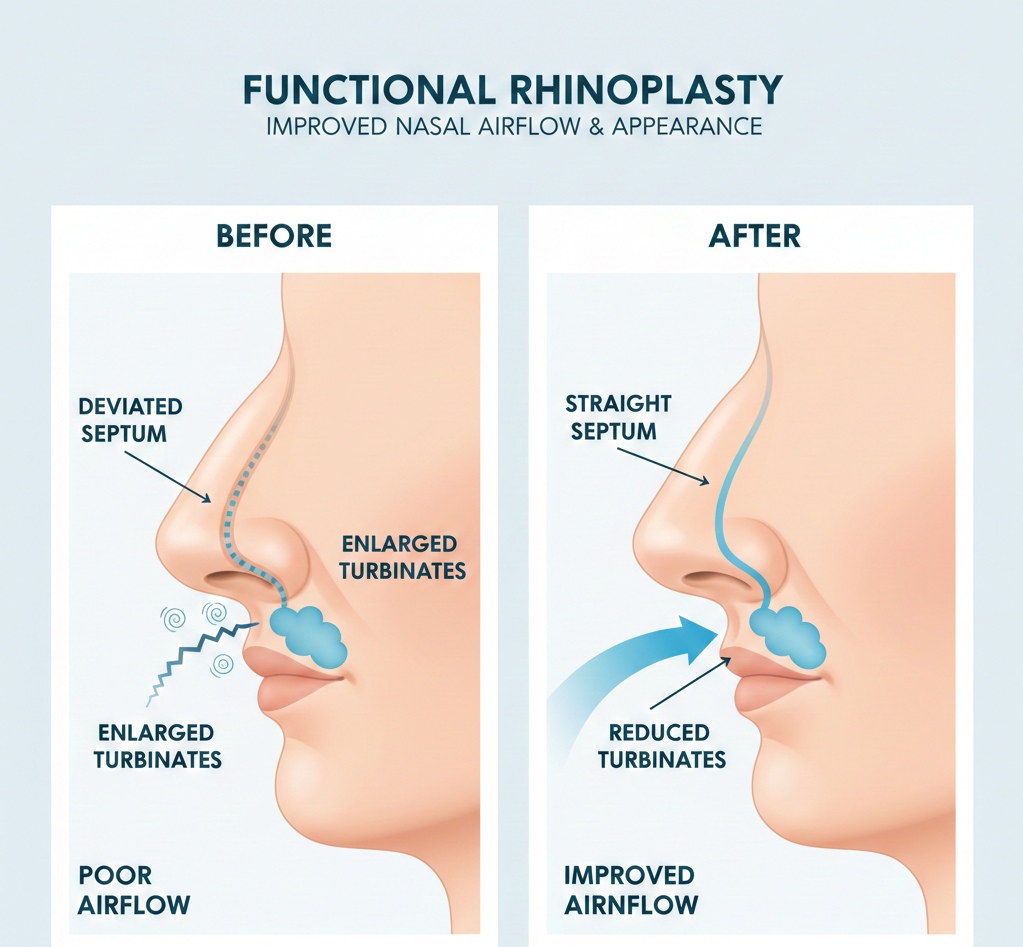
If you struggle to breathe through your nose, wake up with a dry mouth every morning, or can’t get enough air during exercise, the problem may not just be in your head—it’s likely in your nose. While many people think of rhinoplasty as purely cosmetic surgery, functional rhinoplasty addresses the medical issues inside your nose that make breathing difficult.
The beauty of functional rhinoplasty is that it doesn’t have to be an either-or choice. Many patients who need breathing improvements also have aesthetic concerns about their nose’s appearance. Modern functional rhinoplasty can address both issues in a single surgery, improving how you breathe while enhancing how you look.
This comprehensive guide explains everything you need to know about functional rhinoplasty: what it is, how it differs from cosmetic rhinoplasty, what breathing problems it fixes, what the procedure involves, and whether your insurance might cover it. Whether you’re struggling with chronic congestion or simply can’t breathe well through one or both nostrils, functional rhinoplasty might be the solution you’ve been seeking.
What Is Functional Rhinoplasty?
Understanding Functional Rhinoplasty
Functional rhinoplasty is a surgical procedure designed to correct structural abnormalities inside the nose that impair breathing. Unlike cosmetic rhinoplasty, which focuses on changing the external appearance of your nose, functional rhinoplasty primarily addresses the internal anatomy that affects nasal airflow and breathing function.
The term “functional” refers to how well your nose functions as an airway. When structural issues block or restrict airflow, your nose isn’t functioning properly. Functional rhinoplasty restores normal nasal function by correcting these obstructions.
Think of it this way: cosmetic rhinoplasty changes how your nose looks from the outside, while functional rhinoplasty fixes how your nose works on the inside. However, because changes to internal structures can affect external appearance, and vice versa, the two often overlap.
What Makes a Nose “Non-Functional”?
A nose that doesn’t function well has structural problems that restrict airflow through one or both nasal passages. Common issues include:
Deviated Septum: The wall dividing your nasal passages (the septum) is crooked or off-center, blocking airflow on one or both sides. This is the most common cause of nasal obstruction.
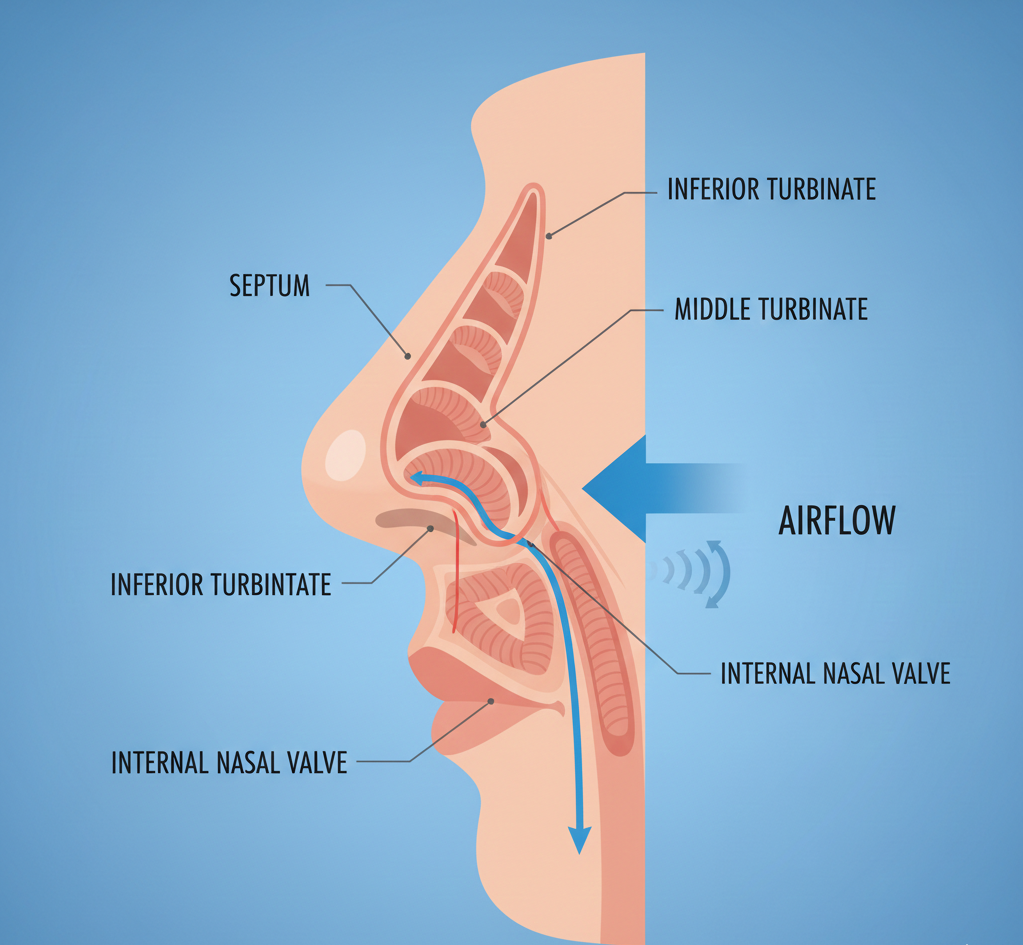
Collapsed Nasal Valves: The nasal valves are the narrowest part of your nasal airway, located where the upper and lower lateral cartilages meet. When these valves are weak or collapse inward, they severely restrict breathing.
Enlarged Turbinates: Turbinates are shelf-like structures inside your nose that warm and humidify air. When chronically inflamed or enlarged, they obstruct airflow.
Previous Trauma: Injuries that broke or displaced nasal bones or cartilage can create internal blockages even if the outside of your nose looks normal.
Previous Surgery Complications: Sometimes, cosmetic rhinoplasty that removed too much structural support can cause the nose to collapse internally, creating breathing problems.
Who Needs Functional Rhinoplasty?
You might be a candidate for functional rhinoplasty if you experience:
- Chronic difficulty breathing through one or both nostrils
- Feeling like you can’t get enough air through your nose
- Mouth breathing, especially during sleep or exercise
- Chronic sinus infections or congestion
- Snoring or sleep apnea related to nasal obstruction
- Nose whistling or unusual breathing sounds
- One nostril that breathes significantly worse than the other
- Headaches or facial pain related to sinus pressure
- Exercise limitation due to inadequate nasal breathing
If these symptoms sound familiar and medications, nasal sprays, or other conservative treatments haven’t provided lasting relief, functional rhinoplasty may be the solution.
Medical Necessity
This is a crucial distinction: functional rhinoplasty is considered medically necessary surgery when it corrects structural problems that significantly impair breathing. Because it’s treating a medical condition rather than just improving appearance, functional rhinoplasty is often covered by health insurance (we’ll discuss this more in the insurance section).
Cosmetic vs Functional Rhinoplasty
Primary Goals
Cosmetic Rhinoplasty: The goal is aesthetic improvement. Patients want to change the size, shape, or proportion of their nose to enhance facial harmony and boost confidence. Breathing function is already normal, or breathing improvements are secondary to cosmetic goals.
Functional Rhinoplasty: The primary goal is restoring normal breathing function. Patients are motivated by medical necessity—they can’t breathe well and it’s affecting their quality of life. Appearance changes are secondary to functional improvements.
What’s Being Fixed
Cosmetic Rhinoplasty: External features like dorsal humps, wide bridges, bulbous tips, nostril width, nose length, or asymmetries. The focus is on bone and cartilage that affects appearance.
Functional Rhinoplasty: Internal structures like deviated septa, collapsed valves, enlarged turbinates, or scar tissue. The focus is on the nasal airway and passage structures.
Insurance Coverage
Cosmetic Rhinoplasty: Not covered by insurance. Considered elective, even if the patient feels strongly that the change is needed. Patients pay entirely out-of-pocket.
Functional Rhinoplasty: Often partially or fully covered by insurance when medically necessary. Requires documentation of breathing problems, failed conservative treatments, and pre-authorization from your insurance company.
Surgeon Specialization
Cosmetic Rhinoplasty: Best performed by plastic surgeons or facial plastic surgeons who specialize in aesthetic nasal surgery. The focus is on artistic skill and achieving beautiful proportions.
Functional Rhinoplasty: Best performed by surgeons with expertise in nasal airway surgery—often ENT (otolaryngology) surgeons or facial plastic surgeons with strong functional training. The focus is on understanding nasal physiology and airflow dynamics.
Motivations
Cosmetic Rhinoplasty: Patients are bothered by their nose’s appearance. They want to look better in photos, feel more confident, or achieve better facial balance.
Functional Rhinoplasty: Patients are frustrated by breathing difficulties. They’re tired of feeling congested, breathing through their mouth, or not being able to exercise comfortably.
Can They Be Combined?
Absolutely! This is increasingly common and often ideal. If you have breathing problems and aesthetic concerns, addressing both in one surgery:
- Requires only one recovery period
- Is more cost-effective than two separate surgeries
- Allows the surgeon to balance function and form
- May result in insurance covering the functional portion while you pay for cosmetic components
Many patients who think they only need cosmetic rhinoplasty discover they also have breathing issues. Conversely, patients seeking functional improvement often realize their nose’s appearance could be enhanced during the same procedure.
Common Breathing Issues Addressed
Deviated Septum
What It Is:
The nasal septum is the wall of cartilage and bone that divides your nose into left and right passages. A deviated septum means this wall is crooked, shifted to one side, or has a prominent bend. Most people have at least a slight deviation, but significant deviations cause breathing problems.
Symptoms:
- One nostril always feels more blocked than the other
- Difficulty breathing through the more blocked side
- Chronic sinus infections on the blocked side
- Snoring due to airflow obstruction
- Facial pain or headaches
How Functional Rhinoplasty Fixes It:
Through a procedure called septoplasty, the surgeon accesses the septum, removes the deviated portions, and straightens the remaining structure. This creates a clear, open airway on both sides. Septoplasty is often the core component of functional rhinoplasty.
Success Rate:
Very high. Over 85% of patients experience significant breathing improvement after septoplasty for a deviated septum.
Nasal Valve Collapse
What It Is:
The nasal valve is the narrowest part of your nasal airway, located about one-third of the way back from your nostril opening. When the cartilage supporting this area is weak, damaged, or surgically over-resected, the valve can collapse inward when you inhale, blocking airflow.
Symptoms:
- Nose feels pinched or narrow when breathing in
- Difficulty getting air through your nose during exercise
- The “Cottle maneuver” helps—when you pull your cheek slightly outward, breathing improves
- Feeling like your nostrils are being sucked closed when you breathe in
How Functional Rhinoplasty Fixes It:
The surgeon reinforces the weak cartilage using grafts (typically from your own septal cartilage, ear cartilage, or rib cartilage). These grafts, called spreader grafts or butterfly grafts, provide structural support to hold the valve open. Sometimes, alar battens are placed to support the nostril walls.
Success Rate:
Good to excellent when grafts are properly placed. Most patients report significant improvement in nasal airflow.
Enlarged Turbinates (Turbinate Hypertrophy)
What It Is:
Turbinates are finger-like structures inside your nose that warm, humidify, and filter air. When chronically inflamed due to allergies, irritants, or medications, they enlarge and obstruct airflow. Think of them as swollen shelves inside your nose that block the passage.
Symptoms:
- Persistent nasal congestion despite allergy medications
- Feeling like your nose is always stuffed, even without a cold
- Difficulty breathing through both nostrils equally
- Post-nasal drip and chronic sinus pressure
How Functional Rhinoplasty Fixes It:
Through a procedure called turbinate reduction, the surgeon shrinks the turbinates using various techniques: partial removal (turbinectomy), cauterization, radiofrequency ablation, or submucous resection (removing the bone inside while preserving the mucous membrane). This opens the airway without sacrificing the turbinates’ important filtering function.
Success Rate:
Very high for immediate improvement, though some patients experience gradual turbinate regrowth over years, especially if allergies aren’t controlled.
Post-Traumatic Nasal Obstruction
What It Is:
Previous nasal injuries—from sports, accidents, or physical trauma—can shift bones, displace cartilage, create internal scarring, or leave fractures that healed in poor alignment. Even old injuries from childhood can cause lifelong breathing problems.
Symptoms:
- Breathing problems that started after a specific injury
- Visible external deformity (crooked nose) combined with breathing issues
- One side completely blocked since the injury
- Internal collapse or narrowing visible when looking up into your nostrils
How Functional Rhinoplasty Fixes It:
The surgeon corrects the damage by straightening displaced bones (osteotomies), repositioning cartilage, removing scar tissue, and rebuilding support structures with grafts. Post-traumatic functional rhinoplasty is often complex because it must address multiple issues simultaneously.
Success Rate:
Good, though results depend on the severity and age of the injury. Old injuries with significant scar tissue can be more challenging.
Previous Rhinoplasty Complications
What It Is:
Sometimes, cosmetic rhinoplasty that focused only on appearance inadvertently created breathing problems by removing too much structural support, over-narrowing the nose, or weakening the nasal valves. This is most common with older rhinoplasty techniques that removed large amounts of cartilage.
Symptoms:
- Breathing that was fine before cosmetic rhinoplasty but became difficult afterward
- Nose that collapses or pinches when breathing in
- External appearance of a pinched or over-narrowed nose
How Functional Rhinoplasty Fixes It:
Through revision rhinoplasty focused on function, the surgeon rebuilds structural support using cartilage grafts, widens narrowed passages, and restores valve function. This is technically demanding surgery requiring significant expertise.
Success Rate:
Moderate to good, depending on how much damage was done and how much usable cartilage remains. Multiple grafts are often needed.
The Functional Rhinoplasty Procedure
Pre-Operative Preparation
Medical Evaluation:
Your surgeon will perform a thorough nasal examination, including looking inside your nostrils with a speculum and possibly using an endoscope (small camera) to visualize internal structures. They may order a CT scan of your sinuses to assess bony anatomy and rule out other issues like chronic sinusitis.
Breathing Tests:
Some surgeons use specialized tests like acoustic rhinometry or rhinomanometry to objectively measure how restricted your airflow is. This documentation helps with insurance approval and provides baseline data to compare after surgery.
Allergy Testing:
If allergies contribute to your congestion, your doctor may recommend allergy testing. Controlling allergies before and after surgery improves outcomes.
Documentation for Insurance:
For insurance coverage, you’ll need documentation of: failed conservative treatments (nasal sprays, allergy medications for at least 3 to 6 months), clinical findings (deviated septum or other structural issues), and sometimes photos or imaging studies showing the obstruction.
The Surgery Itself
Anesthesia:
Functional rhinoplasty is performed under general anesthesia. You’ll be completely asleep and feel nothing during the procedure.
Surgical Approach:
The surgery can be performed using either open or closed rhinoplasty techniques, depending on what needs to be corrected. Many functional procedures can be done closed (all incisions inside the nose), but complex cases may require the open approach for better visualization.
Septoplasty Component:
If you have a deviated septum, the surgeon makes an incision inside your nose to access the septum. The crooked cartilage and bone are removed or straightened, and the septum is repositioned in the midline. This creates equal passages on both sides.
Turbinate Reduction:
If your turbinates are enlarged, the surgeon reduces their size using the chosen technique. This is usually done through the same internal incisions as the septoplasty.
Valve Repair:
If your nasal valves are weak or collapsed, the surgeon places supporting grafts. Spreader grafts (thin strips of cartilage) are placed along the sides of your septum to widen the middle vault. Alar batten grafts support the outer walls. These grafts are secured with tiny sutures.
Additional Corrections:
Any other structural issues—scar tissue, asymmetric cartilage, bony obstructions—are addressed as needed.
Cosmetic Adjustments (if combined):
If you’re combining functional and cosmetic goals, the surgeon will also perform aesthetic changes: reducing a hump, refining the tip, narrowing the bridge, etc.
Surgery Duration:
Functional rhinoplasty typically takes 1.5 to 3 hours, depending on complexity. Combined functional and cosmetic procedures may take 2 to 4 hours.
Immediate Post-Operative Period
You’ll wake up in the recovery room with:
- An external splint protecting your nose
- Possible internal splints or packing to support the septum while it heals
- Some swelling and discomfort (less pain than you might expect)
- Difficulty breathing through your nose initially due to internal swelling
Most patients go home the same day with pain medication, antibiotics (if prescribed), and detailed aftercare instructions.
Recovery Timeline
Week 1:
Significant congestion and swelling. You’ll breathe through your mouth. External splint and internal splints (if used) are removed at day 5 to 7. This removal often provides immediate breathing improvement, though swelling still causes some congestion.
Weeks 2-4:
Internal swelling gradually decreases. Breathing improves week by week as passages open. You can return to work after week 1 or 2. Light exercise is permitted by week 2 to 3.
Months 2-3:
Substantial improvement in breathing. Internal tissues have healed significantly. Most patients feel their breathing is much better than before surgery, though subtle swelling remains.
Months 6-12:
Complete healing. Your breathing is at its optimal level. Any residual internal swelling has fully resolved. This is your final functional result.
Most patients notice dramatic breathing improvement within the first 1 to 3 months, with continued subtle improvement up to one year.
Benefits for Breathing and Beyond
| Category | Benefit | Description |
|---|---|---|
| Primary Breathing Benefits | Improved Nasal Airflow | Air flows smoothly through both nostrils, allowing easy breathing without obstruction or suffocating sensations. |
| Reduced Mouth Breathing | Comfortable nasal breathing naturally reduces mouth breathing, especially during sleep. | |
| Better Sleep Quality | Reduced snoring and improved sleep apnea symptoms lead to better oxygenation and restful sleep. | |
| Enhanced Exercise Performance | Improved oxygen intake boosts endurance and breathing efficiency during workouts. | |
| Fewer Sinus Infections | Proper airflow and mucus drainage reduce chronic sinusitis and recurring infections. | |
| Secondary Health Benefits | Reduced Allergy Symptoms | Improved airflow and drainage help the nose function better during allergy flare-ups. |
| Decreased Headaches | Relieves facial pressure and chronic headaches caused by sinus obstruction. | |
| Improved Sense of Smell | Better airflow allows odor molecules to reach smell receptors more effectively. | |
| Better Medication Effectiveness | Nasal sprays and treatments work more efficiently across the nasal lining. | |
| Reduced Snoring | Correcting nasal obstruction can significantly reduce or eliminate snoring. | |
| Quality of Life Improvements | Improved Confidence | Breathing comfortably improves overall well-being and self-confidence. |
| Better Focus | Improved oxygen supply enhances mental clarity and concentration. | |
| Easier Social Interactions | Eliminates discomfort caused by mouth breathing during conversations. | |
| Enhanced Physical Activity | Better airflow enables more comfortable exercise and increased fitness. | |
| Improved Appearance (if combined) | Patients combining functional and cosmetic rhinoplasty benefit from improved breathing and aesthetics. | |
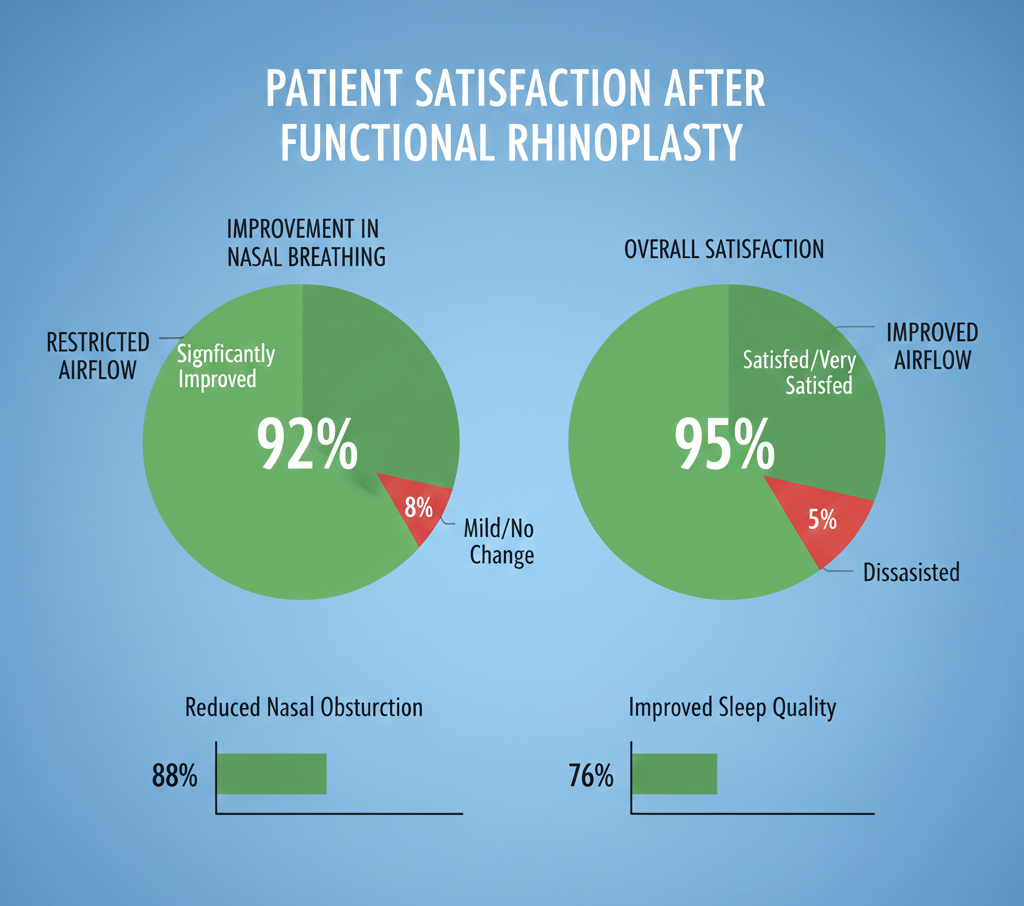
| Long-Term Functional Success | High Success Rate | 85–90% of patients report significant long-term breathing improvement. |
| Long-Term Satisfaction | Patient satisfaction remains high even 5+ years after surgery. | |
| Patient Feedback | Many patients wish they had undergone surgery sooner. | |
| Lifetime Results | Structural corrections remain stable permanently with proper allergy management. |
Insurance Coverage and Medical Necessity
What Insurance Typically Covers
Insurance companies generally cover functional rhinoplasty when it’s medically necessary to treat a documented breathing problem. Specifically, they may cover:
Septoplasty: Straightening a deviated septum that causes nasal obstruction.
Turbinate Reduction: Reducing enlarged turbinates that block airflow and don’t respond adequately to medication.
Nasal Valve Repair: Reconstructing collapsed or weak nasal valves that severely restrict breathing.
Post-Traumatic Correction: Repairing structural damage from documented injuries.
Revision for Breathing Problems: Correcting breathing issues caused by previous surgery.
What Insurance Typically Doesn’t Cover
Cosmetic Changes:
Any modifications done purely for aesthetic reasons—tip refinement, hump removal, nostril narrowing—are not covered.
Elective Improvements:
Even if you personally feel a cosmetic change is necessary, if it’s not correcting a functional breathing problem, insurance won’t cover it.
Combination Procedures:
If you’re having both functional and cosmetic work done simultaneously, insurance will typically cover only the functional portion. You pay out-of-pocket for cosmetic components.
How to Get Insurance Approval
Step 1: Document Your Symptoms
See your primary care doctor or an ENT specialist to document that you have chronic breathing problems. This creates a paper trail of your medical issue.
Step 2: Try Conservative Treatment
Insurance requires proof that you tried non-surgical solutions first. This typically means:
- Using prescription nasal sprays for 3 to 6 months
- Trying allergy medications if appropriate
- Perhaps using nasal dilator strips
- Documenting that these treatments provided inadequate relief
Step 3: Get a Specialist Evaluation
See a surgeon who specializes in functional rhinoplasty. They’ll examine you, possibly order a CT scan, and document the structural problems causing your breathing difficulty.
Step 4: Pre-Authorization
Your surgeon’s office will submit a pre-authorization request to your insurance company. This includes:
- Clinical notes documenting your nasal obstruction
- Records of failed conservative treatments
- Description of the structural problems (deviated septum, etc.)
- Sometimes photos or imaging studies
Step 5: Approval Process
Insurance reviews the request and either approves, denies, or requests more information. If denied initially, you can appeal with additional documentation.
Step 6: Understand Your Coverage
Even with approval, you’ll likely have:
- A deductible to meet
- Co-insurance (you pay a percentage, typically 10 to 20%)
- Co-pays for surgeon visits
- Possible out-of-pocket maximums
Typical Coverage Scenarios
Scenario 1: Purely Functional
You need only breathing improvements (septoplasty and turbinate reduction). Your out-of-pocket cost is your deductible plus co-insurance—typically $1,000 to $3,000 depending on your plan.
Scenario 2: Functional with Minor Cosmetic
You need breathing improvements and also want a dorsal hump removed. Insurance covers the functional portion. You pay out-of-pocket for the cosmetic hump removal—typically an additional $3,000 to $5,000.
Scenario 3: Combined Functional and Cosmetic
You need breathing improvements and want significant cosmetic changes (tip refinement, narrowing, hump removal). Insurance covers functional components. You pay the difference, which might be $5,000 to $10,000 depending on the extent of cosmetic work.
Scenario 4: Purely Cosmetic
You have no breathing problems but want cosmetic changes only. Insurance covers nothing. You pay the full rhinoplasty cost out-of-pocket—typically $8,000 to $15,000.
Appealing a Denial
If your insurance denies coverage:
- Request a detailed explanation of why it was denied
- Gather additional documentation (more detailed doctor’s notes, objective breathing tests, photos showing septal deviation)
- Have your surgeon write a letter of medical necessity explaining why surgery is needed
- Submit a formal appeal with all supporting documentation
- If denied again, you can request an external review
Many denials are overturned on appeal when sufficient documentation is provided.
Before and After Expectations
Setting Realistic Expectations
Breathing Improvement Timeline:
Don’t expect to breathe perfectly immediately after surgery. Here’s the realistic timeline:
- Week 1: Still very congested due to swelling. You may feel like you’re breathing worse than before surgery (this is temporary).
- Week 2: Internal splints are out, you can breathe somewhat, but swelling still causes congestion.
- Month 1: Noticeable improvement. You’re breathing better than before surgery, though not yet at the final result.
- Month 3: Substantial improvement. Most patients feel their breathing is much better.
- Months 6-12: Final result. Breathing is at its optimal level.
Degree of Improvement:
Most patients experience 70 to 90% improvement in nasal breathing. “Perfect” breathing may not be achievable if you have other factors like chronic allergies, but the improvement is typically life-changing.
Visual Changes:
If you had purely functional rhinoplasty with no cosmetic goals, your nose may look slightly different from the outside:
- Removing a large septal spur might make your nose slightly straighter
- Valve repair grafts might make your middle vault slightly wider
- The overall profile may be subtly different
If you combined functional and cosmetic rhinoplasty, you’ll see intentional aesthetic improvements plus functional benefits.
What Success Looks Like
Functional Success:
- You can breathe through both nostrils comfortably
- You no longer mouth-breathe during the day or night
- You can exercise without feeling air-starved
- You sleep better and wake up without dry mouth
- Your chronic congestion and sinus infections decrease or resolve
Patient Satisfaction:
- 85 to 90% of functional rhinoplasty patients are satisfied with their breathing improvement
- Most report they wish they’d had the surgery sooner
- Quality of life improvements are substantial
Potential Disappointments to Prepare For
Incomplete Resolution:
If you have multiple factors contributing to nasal congestion (structural issues plus severe allergies plus chronic sinusitis), functional rhinoplasty fixes only the structural component. You may need ongoing allergy management.
Temporary Worsening:
The first 1 to 2 weeks post-op, you’ll breathe worse than before surgery due to swelling. This causes anxiety for some patients, but it’s temporary.
Residual Turbinate Issues:
Even after turbinate reduction, turbinates can swell with allergies or irritants. Surgery makes them smaller baseline, but they still react to triggers.
Unexpected Appearance Changes:
If you wanted purely functional surgery with no cosmetic changes, subtle external differences may occur. Discuss this risk with your surgeon.
Slow Healing:
Some patients with very thick nasal skin or significant scarring heal more slowly. Patience is required.
Measuring Your Results
Subjective Assessment:
The most important measure is how you feel. Can you breathe comfortably? Do you sleep better? Can you exercise without limitation? These subjective improvements matter most.
Objective Measures:
Some surgeons perform post-operative breathing tests (rhinomanometry) to objectively measure airflow improvement. This can be satisfying validation that your breathing has improved measurably.
Photographic Documentation:
Before and after photos help you see any external changes. For combined functional-cosmetic procedures, photos show the aesthetic improvements alongside functional benefits.
Combining Functional and Cosmetic Goals
Why Combine Procedures?
Single Recovery Period:
Going through recovery once for both functional and cosmetic improvements is more efficient than having two separate surgeries with two separate recoveries.
Cost Savings:
Having both done simultaneously is cheaper than two separate procedures. You pay one anesthesia fee, one facility fee, and have less time off work.
Better Overall Result:
A surgeon addressing both function and form can create a nose that both works well and looks harmonious. Sometimes functional improvements inadvertently improve appearance, and vice versa.
Insurance Help:
Insurance covering the functional portion reduces your total out-of-pocket cost, even if you’re paying for the cosmetic components.
Having the Conversation with Your Surgeon
Be honest about both your functional concerns and any aesthetic goals. Many patients feel hesitant to mention cosmetic concerns when their primary issue is breathing, but your surgeon needs to know about both to create the best surgical plan.
Ask:
- “Can we address both my breathing and appearance in one surgery?”
- “What would that involve?”
- “How does combining goals affect the procedure, recovery, or cost?”
- “What will insurance cover versus what I’ll pay out-of-pocket?”
A good surgeon will discuss both aspects openly and help you understand the full picture.
Prioritizing Function
If you’re combining functional and cosmetic goals, always prioritize function. Your surgeon should never compromise breathing function to achieve an aesthetic goal. A beautiful nose that doesn’t breathe well is not a successful rhinoplasty.
Final Thoughts: Breathing Better, Living Better
Functional rhinoplasty is one of the most life-changing procedures in medicine because breathing is so fundamental to everything you do. When you can’t breathe properly, it affects your sleep, exercise, energy levels, mental clarity, and overall quality of life. Most people don’t realize how much chronic nasal obstruction was holding them back until after it’s fixed.
If you’ve been struggling with breathing difficulties, chronic congestion, or nasal obstruction that hasn’t improved with medications, functional rhinoplasty may be the solution. The combination of high success rates, potential insurance coverage, and the option to address cosmetic concerns simultaneously makes it an attractive option for many patients.
The key is finding a surgeon with expertise in both the functional and aesthetic aspects of rhinoplasty. Look for board certification, extensive experience with functional nasal surgery, and a track record of successful outcomes. Don’t be afraid to ask about their approach to preserving or improving breathing while achieving aesthetic goals.
Your nose is the first thing that brings air into your body. Making sure it works properly isn’t vanity, it’s fundamental to your health and well-being.