 Skip to content
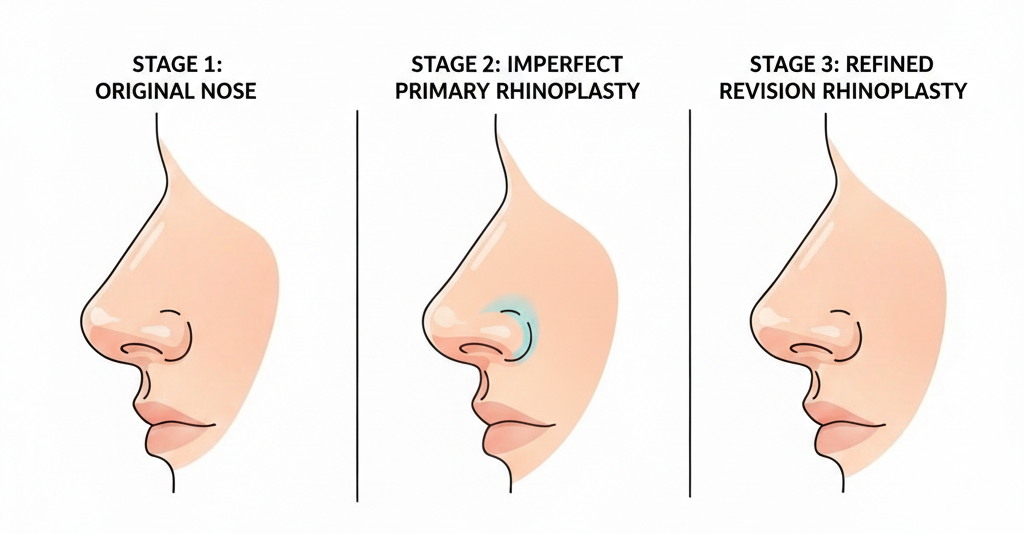
Not every rhinoplasty achieves the desired result the first time. Whether due to healing complications, surgical technique, unrealistic expectations, or simply the unpredictable nature of how your body responds to surgery, an estimated 10 to 15% of rhinoplasty patients eventually seek revision surgery. If you’re unhappy with your rhinoplasty results, you’re not alone, and more importantly, you’re not without options.
Revision rhinoplasty, also called secondary rhinoplasty, is a specialized procedure to correct or improve the results of a previous nose surgery. It’s one of the most technically challenging procedures in facial plastic surgery because your surgeon must work with altered anatomy, scar tissue, and often limited cartilage. But in skilled hands, revision rhinoplasty can transform an unsatisfactory result into the nose you originally hoped for.
This comprehensive guide covers everything you need to know about revision rhinoplasty: what it is, why it’s needed, when to consider it, why it’s more complex than primary rhinoplasty, how to find the right surgeon, what recovery looks like, and what success rates and realistic expectations should be. Whether you’re considering revision or simply want to understand why it might be necessary, this article provides the complete picture.
What Is Revision Rhinoplasty?
Defining Revision Rhinoplasty
Revision rhinoplasty is any rhinoplasty performed to correct, refine, or improve the results of a previous nose surgery. It’s called “revision” because the surgeon is revising or correcting the work that was done before. This can range from minor tweaks to address small asymmetries to major reconstructive surgery to fix significant problems.
The term “secondary rhinoplasty” means the same thing—it’s your second nose surgery. Some patients need a third rhinoplasty (tertiary) or even more, though with each subsequent surgery, the challenges increase and the options narrow.
How Common Is Revision Rhinoplasty?
Industry-wide, approximately 10 to 15% of rhinoplasty patients eventually seek some form of revision. This includes:
- Major revisions: Significant corrections needed due to poor aesthetic results or functional problems (5 to 7% of cases)
- Minor revisions: Small refinements or tweaks to address minor issues (5 to 8% of cases)
These statistics don’t mean 10 to 15% of rhinoplasties “fail.” Many revisions are for subtle refinements that don’t indicate the original surgery was unsuccessful—just that the patient wants further improvement.
Types of Revision Rhinoplasty
Cosmetic Revision:
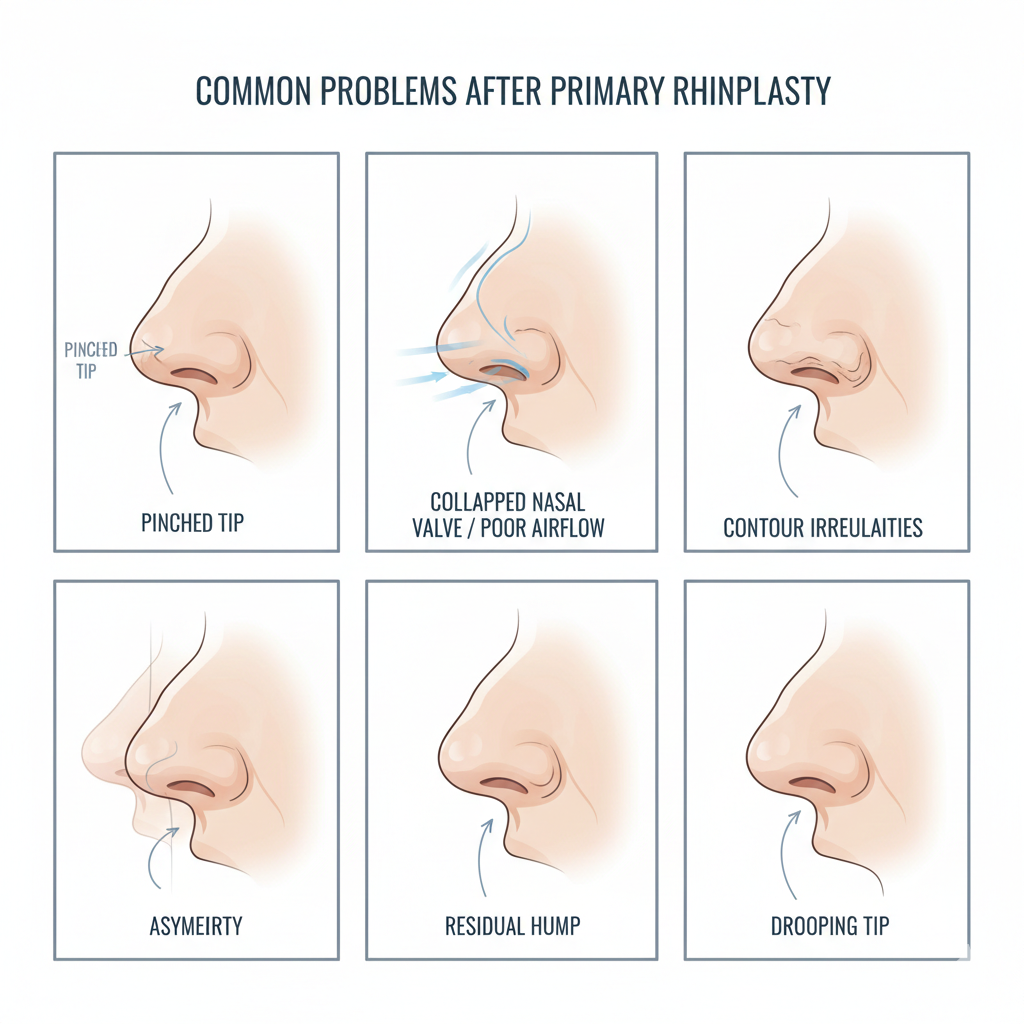
Correcting aesthetic issues like asymmetry, residual hump, over-rotated tip, pinched appearance, or results that simply don’t match the patient’s goals.
Functional Revision:
Addressing breathing problems that developed after the primary surgery, such as collapsed nasal valves, internal scarring causing obstruction, or over-resection of structural support.
Combined Revision:
Many revision rhinoplasties address both cosmetic and functional concerns simultaneously.
Minor Revision:
Small adjustments using minimal surgery, sometimes performed in-office under local anesthesia. Examples include adding filler to camouflage small irregularities or removing a tiny bone or cartilage irregularity.
Major Revision:
Extensive reconstruction requiring grafts, significant tissue manipulation, and sometimes multiple stages. These are complex surgeries requiring highly specialized expertise.
Why Revision Rhinoplasty Is Needed
Healing and Scar Tissue Issues
Unpredictable Healing:
Everyone heals differently. Even with perfect surgical technique, your body’s healing response can create unexpected results. Scar tissue may form unevenly, pulling structures into unexpected positions. Swelling may resolve asymmetrically, creating temporary or permanent irregularities.
Thick Skin Challenges:
Patients with very thick nasal skin (common in certain ethnicities) may not see the refined definition the surgeon created internally. The skin doesn’t contract tightly around the new framework, leaving results less defined than planned.
Scar Tissue Contracture:
As internal scars mature over 12 to 18 months, they can contract and pull on structures, gradually changing the nose’s shape. This can cause the tip to drop, the nostrils to narrow, or other subtle changes.
Surgical Technique Issues
Over-Resection:
Removing too much cartilage or bone can weaken the nose’s structure, causing collapse, pinching, or breathing problems. This was more common with older rhinoplasty techniques that removed large amounts of tissue.
Under-Resection:
Not removing enough can leave a residual hump, insufficient tip refinement, or a nose that doesn’t look significantly different from before surgery.
Asymmetric Corrections:
If the surgeon didn’t address asymmetries adequately or created new asymmetries during surgery, one side may look different from the other.
Inadequate Structural Support:
Failing to place supporting grafts when needed can lead to collapse over time, particularly in the nasal valves or tip.
Poor Graft Placement:
Grafts that shift, become visible through skin, or are positioned incorrectly can create contour irregularities or breathing problems.
Communication and Expectation Mismatches
Different Aesthetic Visions:
Sometimes the surgeon achieved what they considered a good result, but it doesn’t match what the patient wanted. This often happens when pre-operative communication about goals wasn’t detailed enough.
Unrealistic Expectations:
If a patient expected their nose to look exactly like a celebrity’s or expected perfection, they may be dissatisfied with results that are actually quite good.
Incomplete Understanding:
Patients who didn’t understand that swelling takes 12 to 18 months to fully resolve may seek revision prematurely when their nose is still changing.
Functional Problems After Surgery
Nasal Valve Collapse:
Removing too much cartilage support can cause the nasal valves (the narrowest part of the airway) to collapse inward when breathing, causing obstruction.
Internal Scar Tissue:
Excessive internal scarring can narrow airways and restrict breathing.
Septal Perforation:
A hole in the septum (rare but serious) can cause whistling, crusting, bleeding, and breathing difficulty.
Turbinate Problems:
If turbinates were reduced too aggressively, it can paradoxically cause a sensation of obstruction (empty nose syndrome, though rare).
Trauma After Healing
Post-Surgical Injury:
If you suffer a nasal injury after your rhinoplasty has healed, it can displace or damage the surgical result, requiring revision to restore it.
Minor Bumps:
Even small trauma during the healing period (first 6 to 12 months) can shift structures before they’re fully stable.
Time and Aging
Long-Term Changes:
Over many years (5 to 10+), your nose continues aging. Skin thins, cartilage weakens, and tip support may gradually decrease, causing the tip to droop. Some patients seek revision decades later to restore their original result.
Weight Changes:
Significant weight gain or loss can change facial proportions, making a nose that once looked perfect seem too large or too small.
When to Consider Revision Rhinoplasty
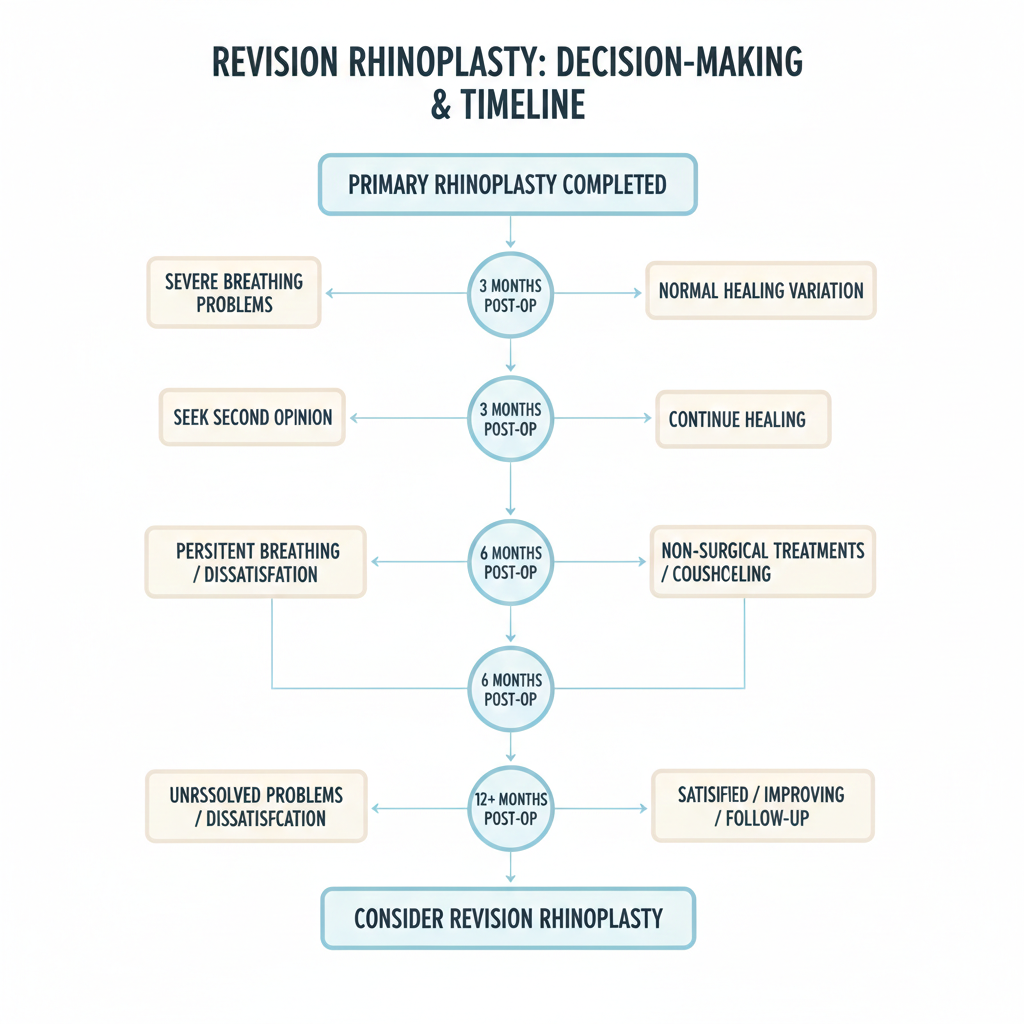
The One-Year Rule
Wait at Least 12 Months:
This is the most important rule in revision rhinoplasty. You must wait a minimum of one year after your primary surgery before considering revision. Here’s why:
- Swelling takes 12 to 18 months to completely resolve, especially in the tip
- Your nose continues changing shape as scar tissue matures
- What looks concerning at 3 months may resolve beautifully by 12 months
- Surgeons cannot accurately assess your true result until full healing occurs
Operating too early means revising a nose that’s still changing, which can lead to unpredictable results and the need for yet another revision.
Exceptions to the One-Year Rule:
Only severe functional problems (complete nasal obstruction, septal perforation) or major structural collapse justify earlier revision. Even then, many surgeons prefer to wait if the situation isn’t urgent.
Signs You May Need Revision
Functional Issues:
- Persistent difficulty breathing through your nose after the healing period
- Breathing that was good initially but worsened over time
- Whistling sounds when breathing
- Chronic nasal crusting or bleeding
- Sleep disruption due to nasal obstruction
Aesthetic Concerns:
- Significant asymmetry that didn’t resolve with healing
- Visible irregularities, bumps, or depressions
- Results that don’t match your goals or expectations
- Tip that’s too upturned (over-rotated), too droopy, or too pinched
- Bridge that’s too wide, too narrow, or has a residual hump
- Nostril asymmetry or distortion
Psychological Distress:
- Persistent unhappiness with your appearance after full healing
- Avoidance of photos or social situations due to nose concerns
- Regret about having the surgery
When Revision May Not Be Needed
Normal Healing Variations:
Minor asymmetries, subtle irregularities visible only to you in certain lighting, or results that don’t match your “ideal” but still look good may not warrant additional surgery.
Unrealistic Expectations:
If your nose looks objectively good but doesn’t look exactly like a celebrity’s or doesn’t achieve “perfection,” revision may not help. Consider therapy to address body image concerns before pursuing revision.
Minor Issues:
Very small irregularities that bother you but aren’t noticeable to others might be addressed with non-surgical options like filler to camouflage contour issues.
Getting a Second Opinion
Before committing to revision rhinoplasty, consult with at least two or three revision specialists (not your original surgeon initially). They can provide objective assessments of:
- Whether revision is actually needed
- What can realistically be improved
- What the risks and limitations are
- Whether your concerns are valid surgical issues or expectations misalignment
Considering Your Original Surgeon
Pros of Returning:
- They know your anatomy and what they did
- They may perform minor revisions at reduced cost or no cost if they agree there’s an issue
- Familiar relationship and trust (if you still trust them)
Cons of Returning:
- They created the problem, so can they fix it?
- May be defensive and downplay your concerns
- May not have the advanced revision skills needed
- Difficult emotional dynamic
When to Return:
If the issue is minor and your surgeon is open to addressing it, returning can work. If the issue is major or your trust is broken, seek a revision specialist.
Complexity and Challenges
Why Revision Is Significantly Harder
Altered Anatomy:
Your nose no longer has its original structure. Cartilage has been removed or repositioned, bone has been shaved or broken, and the surgeon must work with what remains rather than pristine, untouched anatomy.
Scar Tissue:
Previous surgery creates internal scar tissue that obscures normal tissue planes, makes dissection more difficult, distorts anatomy, and reduces blood supply. Working through scar tissue is like trying to assemble a puzzle that’s glued together.
Limited Cartilage:
The primary surgery may have used much of your septal cartilage. Revision often requires grafts from your ear or ribs, which is more complex and creates additional donor site discomfort.
Compromised Blood Supply:
Previous surgery disrupted some blood vessels. Revision surgery must work carefully to preserve remaining blood supply, limiting surgical options.
Weakened Structures:
If too much cartilage was removed, structures may be weak and require extensive reinforcement with grafts to prevent collapse.
Unpredictable Healing:
Tissues that have been operated on twice heal less predictably than virgin tissues. Scar tissue formation is more pronounced, and results may be less refined.
Technical Challenges for Surgeons
Limited Visualization:
Scar tissue makes it difficult to see normal landmarks and anatomy, even with open rhinoplasty’s direct access.
Fragile Tissues:
Previously operated tissues are more delicate and prone to damage during dissection.
Grafting Requirements:
Most revision rhinoplasties require multiple cartilage grafts to rebuild support or augment deficient areas. Sculpting, placing, and securing these grafts is technically demanding.
Achieving Symmetry:
Correcting asymmetries created by the first surgery is challenging when one side healed differently than the other.
Managing Patient Expectations:
Patients who’ve already been disappointed once have higher anxiety and sometimes unrealistic hopes that revision will achieve “perfection.”
Why Revision Surgeons Need Special Expertise
Revision rhinoplasty is considered one of the most difficult procedures in facial plastic surgery. It requires:
- Advanced understanding of nasal anatomy and physiology
- Extensive experience with cartilage grafting techniques
- Ability to problem-solve complex structural issues
- Excellent judgment about what’s achievable
- Patience and meticulous surgical technique
Not all rhinoplasty surgeons are qualified to perform complex revision work. This is why finding the right surgeon is so critical.
Finding the Right Surgeon
Essential Qualifications
Board Certification:
Your surgeon must be board-certified by the American Board of Plastic Surgery or the American Board of Facial Plastic and Reconstructive Surgery. This ensures they’ve completed rigorous training and passed comprehensive exams.
Revision Rhinoplasty Specialization:
Look for surgeons who specifically advertise expertise in revision rhinoplasty and perform it regularly (ideally 30 to 50+ revision cases per year). This is a subspecialty within rhinoplasty.
Fellowship Training:
Many top revision specialists completed fellowship training specifically in rhinoplasty or facial plastic surgery beyond their residency. This indicates advanced, focused training.
Published Research or Teaching:
Surgeons who publish papers on revision rhinoplasty or teach other surgeons are often leaders in the field with exceptional expertise.
Hospital Privileges:
Even if surgery will be at an outpatient center, hospital privileges indicate the surgeon has been vetted by a medical institution.
Evaluating Experience
Ask Specific Questions:
- “What percentage of your rhinoplasty practice is revision work?” (Should be at least 30 to 50% for true revision specialists)
- “How many revision rhinoplasties do you perform per year?” (Should be substantial—30+ annually)
- “Are you comfortable using rib cartilage grafts?” (Often necessary for complex revisions)
- “Can you show me before and after photos of revision cases similar to mine?”
Review Before and After Photos:
Look for photos of revision cases, not just primary rhinoplasties. Pay attention to how they handle cases similar to yours. Ask to see results at one year or longer, not just immediate post-op.
Read Reviews Carefully:
Focus on reviews from revision rhinoplasty patients specifically. How did they feel about their experience? Did the surgeon set realistic expectations? Were they satisfied with results?
Red Flags to Avoid
Promises of Perfection:
Any surgeon guaranteeing a “perfect” result or claiming they can make your nose exactly like a photo doesn’t understand the limitations of revision surgery.
Minimal Revision Experience:
A surgeon who primarily does primary rhinoplasty but only occasional revisions doesn’t have the specialized expertise needed.
Dismissing Your Concerns:
If a surgeon downplays your concerns, insists your nose looks fine, or seems defensive about criticizing another surgeon’s work, find someone else.
Rushing Timeline:
Any surgeon willing to do your revision before 12 months (without urgent functional issues) doesn’t follow proper protocols.
Lack of Grafting Experience:
If the surgeon doesn’t routinely use rib or ear cartilage grafts, they may not be equipped to handle complex revisions.
No Clear Surgical Plan:
A qualified surgeon should explain specifically what went wrong, what they’ll do to fix it, what grafts will be needed, and what limitations exist.
The Consultation Process
Expect Thoroughness:
A good revision consultation takes 45 to 90 minutes. The surgeon should examine your nose externally and internally, review your primary surgery details if available, and discuss your concerns in depth.
Bring Documentation:
If possible, bring:
- Photos of your nose before your primary rhinoplasty
- Operative report from your primary surgery (request this from your original surgeon)
- Any imaging studies (CT scans)
- Timeline of your concerns
Ask About Limitations:
A trustworthy surgeon will be honest about what can and cannot be improved. Some issues have limitations—thick skin won’t drape perfectly no matter what, severe cartilage deficiency limits options, etc.
Discuss Realistic Outcomes:
The surgeon should explain what you can realistically expect, including that perfection isn’t achievable and that some compromises may be necessary.
Get Multiple Opinions:
Consult with at least 2 to 3 revision specialists. Hearing different perspectives helps you make an informed decision. If all three surgeons suggest similar approaches, that’s reassuring. If opinions differ wildly, dig deeper.
Trust Your Instincts
You should feel:
- Confident in the surgeon’s expertise
- Comfortable asking questions
- Heard and understood regarding your concerns
- Realistic optimism about potential improvements
- Trust that the surgeon has your best interests in mind
If something feels off the surgeon is dismissive, pushy, overly optimistic, or you simply don’t click keep searching.
The Revision Rhinoplasty Procedure
Pre-Operative Planning
Detailed Analysis:
Your surgeon will create a comprehensive surgical plan addressing each specific issue. This may include computer imaging to show realistic potential results (with the caveat that revision results are less predictable).
Graft Harvesting Planning:
If rib or ear cartilage grafts are needed, your surgeon will explain where they’ll harvest the cartilage and what to expect from the donor site.
Medical Clearance:
Especially for longer, more complex revisions, you may need medical clearance from your primary care doctor and pre-operative blood work.
The Surgery
Longer Duration:
Revision rhinoplasty typically takes 3 to 5 hours, significantly longer than primary rhinoplasty (which averages 2 to 3 hours). Complex revisions can take 6+ hours.
Open Approach:
Nearly all revision rhinoplasties use the open technique because visibility is essential when working through scar tissue and placing multiple grafts.
Graft Harvesting:
If rib cartilage is needed (common for major revisions), the surgeon first harvests it through a small incision in your chest. If ear cartilage is needed, it’s taken from behind your ear. This adds time and creates an additional wound.
Structural Reconstruction:
The surgeon carefully works through scar tissue to access the nasal framework, removes problematic structures or scar tissue, places supporting or augmenting grafts, and rebuilds the structure to correct problems.
Meticulous Closure:
Because revision surgery is already more prone to swelling and healing issues, closure is done with extreme care to minimize trauma and optimize healing.
Anesthesia
General anesthesia is used for revision rhinoplasty. You’ll be completely asleep. The longer surgical time means you’ll be under anesthesia longer than primary rhinoplasty, but this is well-tolerated by healthy patients.
Recovery Differences from Primary Rhinoplasty
Immediate Post-Operative Period
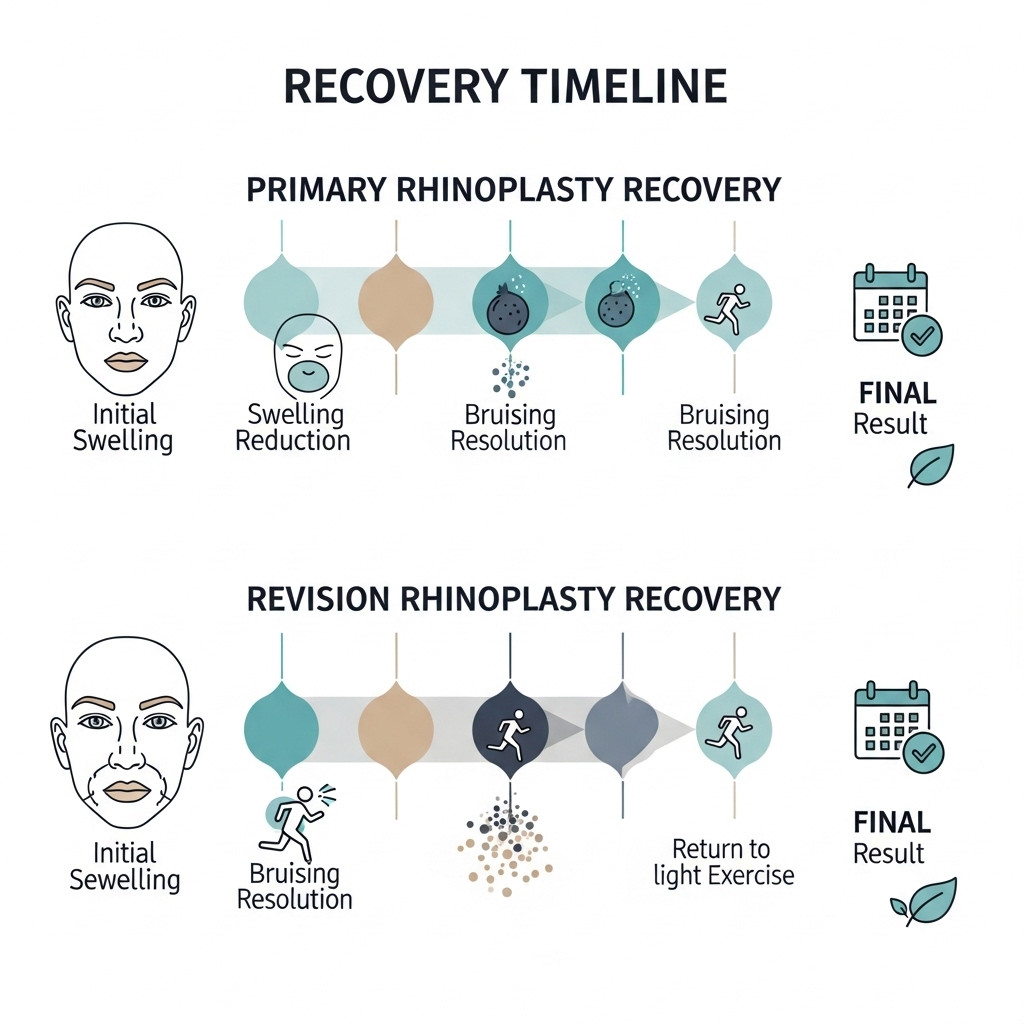
More Swelling:
Expect more swelling with revision than you had with your primary rhinoplasty. The tissues have been traumatized twice, and scar tissue affects drainage.
More Discomfort:
Pain levels are typically higher than primary rhinoplasty, though still manageable with medication. If you had rib grafts, chest discomfort adds to the recovery burden.
Longer Splint Time:
Some surgeons leave the external splint on for 7 to 10 days for revision cases instead of the typical 5 to 7 days.
Potential Drains:
Rarely, surgeons may place small drains to prevent fluid accumulation, which aren’t typically used in primary rhinoplasty.
First Few Weeks
Bruising:
May be more extensive and last longer than your first surgery.
Activity Restrictions:
You may need to be more cautious about returning to activities. Some surgeons recommend waiting 3 to 4 weeks before moderate exercise instead of 2 to 3 weeks.
Donor Site Healing:
If you had rib grafts, expect chest discomfort when breathing deeply, coughing, or moving certain ways for 2 to 4 weeks. The small chest incision heals quickly but can be sore.
Months 1-6
Slower Swelling Resolution:
Swelling takes longer to resolve in revision cases. While primary rhinoplasty patients see 70% of swelling gone by month 2, revision patients may only be at 50 to 60% at that point.
Prolonged Stiffness:
Your nose may feel stiff and tight for a longer period due to increased internal scarring.
Slower Breathing Improvement:
If functional issues were addressed, breathing improvement may be more gradual than after primary rhinoplasty.
Months 6-18
Extended Final Result Timeline:
Revision rhinoplasty can take 18 to 24 months to see the true final result, compared to 12 to 18 months for primary rhinoplasty. Thick-skinned patients may need even longer.
Unpredictable Refinement:
The tip and bridge may continue changing more than expected as scar tissue matures. Stay in close follow-up with your surgeon.
Costs and Insurance Considerations
Revision Rhinoplasty Costs
Higher Than Primary Rhinoplasty:
Revision rhinoplasty typically costs 30 to 50% more than primary rhinoplasty due to:
- Longer surgical time (more OR time costs)
- Increased complexity requiring specialized expertise
- Potential need for rib or ear cartilage grafts
- Higher surgeon fees for revision specialists
Average Cost Range:
$10,000 to $20,000+ for revision rhinoplasty, compared to $5,500 to $12,000 for primary rhinoplasty. Complex revisions with rib grafts can exceed $25,000.
Geographic Variation:
Major metropolitan areas charge more. New York, Los Angeles, and San Francisco revision specialists may charge $15,000 to $30,000+.
What Affects the Cost
Complexity:
Minor revisions cost less than major reconstructions.
Graft Needs:
Septal cartilage grafts (using existing cartilage in your nose) are included in the base fee. Rib or ear cartilage grafts increase cost.
Surgeon Expertise:
Top revision specialists command premium fees for their rare expertise.
Facility Fees:
Longer surgery means higher facility costs.
Anesthesia:
More time under anesthesia costs more.
Insurance Coverage
Usually Not Covered:
Most revision rhinoplasty is considered cosmetic and therefore not covered by insurance, even if your primary surgery had insurance coverage for functional components.
Exceptions:
If the revision is addressing new functional problems (breathing issues, septal perforation, valve collapse) caused by the primary surgery, insurance may cover the functional portion.
Proving Medical Necessity:
You’ll need documentation that the first surgery created medical problems, not just aesthetic dissatisfaction.
Original Surgeon’s Responsibility
No Guarantees:
Rhinoplasty results aren’t guaranteed. Even with perfect technique, healing can create unexpected outcomes.
Complimentary Revisions:
Some surgeons offer to perform minor revisions at reduced cost or free of charge within a certain timeframe (typically 1 to 2 years) if they agree an issue exists.
When They Don’t:
If your original surgeon believes your result is good and you’re simply unhappy, they’re not obligated to offer free revision.
Getting Revision Elsewhere:
If you choose a different surgeon for revision (common and often wise), you pay full price.
Success Rates and Realistic Expectations
Success Rate Statistics
Overall Satisfaction:
Approximately 75 to 85% of revision rhinoplasty patients are satisfied with their results—lower than the 85 to 90% satisfaction rate for primary rhinoplasty.
Need for Further Revision:
About 10 to 15% of revision patients eventually seek a second revision (third rhinoplasty overall). With each subsequent surgery, satisfaction rates decline and complications increase.
Functional Improvement:
When addressing breathing issues, revision rhinoplasty has good success rates (70 to 85% report improvement), though not quite as high as primary functional rhinoplasty.
Setting Realistic Expectations
Improvement, Not Perfection:
The goal of revision rhinoplasty is significant improvement, not perfection. Your nose will look better and/or breathe better, but it may not be perfect.
Limitations:
Some issues have inherent limitations. Very thick skin won’t allow crisp definition. Severe cartilage depletion limits structural options. Extensive scarring may prevent ideal symmetry.
Trade-Offs:
Sometimes, achieving one goal requires accepting a compromise elsewhere. For example, widening internal valves to improve breathing may make the bridge slightly wider externally.
Healing Unpredictability:
Revision rhinoplasty healing is less predictable than primary surgery. Your result may differ somewhat from the surgical plan due to scar tissue formation.
Timeline Patience:
You must be patient for 18 to 24 months to see the true result. Judging too early leads to unnecessary anxiety.
What Good Results Look Like
Functional Success:
- Significant breathing improvement (70%+ better than after primary surgery)
- Elimination of whistling, crusting, or obstruction
- Ability to breathe comfortably through both nostrils
Aesthetic Success:
- Major asymmetries corrected or significantly improved
- Visible irregularities smoothed or eliminated
- Overall appearance that’s harmonious and natural
- Result that matches your goals (even if not “perfect”)
Patient Satisfaction:
- Relief at finally having better form and/or function
- Confidence improvement
- No longer avoiding photos or social situations
- Feeling the revision was worth the additional surgery
When to Accept Your Result
After 18 to 24 months, if your nose looks significantly better than after your primary surgery, breathes well, and looks natural, it’s time to accept the result even if minor imperfections remain. Chasing absolute perfection through multiple revisions leads to diminishing returns and increasing complications.
Consider therapy if you:
- Are fixated on minor flaws nobody else notices
- Have had multiple surgeries without feeling satisfied
- Can’t stop scrutinizing your nose despite objective improvement
Preventing the Need for Revision
Choosing the Right Surgeon Initially
The Most Important Factor:
The best way to avoid needing revision is choosing an excellent surgeon for your primary rhinoplasty. Do extensive research, look at many before/afters, read reviews, and get multiple consultations.
Clear Communication
Detailed Goal Discussion:
Use photos, computer imaging, and specific language to ensure you and your surgeon share the same vision.
Realistic Expectations:
Understand what rhinoplasty can and cannot achieve. Don’t expect perfection or to look exactly like someone else.
Following Post-Operative Instructions
Protect Your Nose:
Avoid trauma during healing. Even small bumps can shift structures before they’re fully stable.
Be Patient:
Don’t judge results until 12 to 18 months post-op. What looks concerning at 3 months may resolve beautifully.
Waiting the Full Year
Give It Time:
Many perceived “problems” at 6 months resolve by 12 months. Wait the full year before considering revision.
Final Thoughts
If you’re unhappy with your rhinoplasty results, know that revision rhinoplasty can often significantly improve your outcome. While it’s more complex, takes longer to heal, and costs more than primary rhinoplasty, it offers hope for correction.
The keys to successful revision are:
- Waiting at least 12 months before pursuing it
- Finding a true revision specialist with extensive experience
- Having realistic expectations about improvement
- Being patient with the healing process
- Accepting that perfection may not be achievable
Many patients who were devastated by their primary rhinoplasty results find satisfaction and relief after skilled revision surgery. The journey is longer and more challenging, but for those truly bothered by functional or aesthetic problems, it’s absolutely worth pursuing.
Take your time finding the right surgeon, ask all your questions, and move forward with confidence that improvement is possible.