 Skip to content
A disappointing rhinoplasty result is one of the most frustrating experiences a patient can face. You committed to the process, went through surgery and recovery, and the result is still not right. Maybe breathing is harder than before. Maybe the tip looks pinched or asymmetric. Maybe a bump that was supposed to be gone is still there. Whatever the issue, your situation is not permanent.
Cincinnati has plastic surgeons who offer revision rhinoplasty. What is rare is a surgeon who performs over 300 rhinoplasty per year with a specific focus on complex revision cases. Dr. Ziad Katrib, MD FACS is based in Louisville, KY, under two hours from Cincinnati, and offers virtual consultations for all Ohio patients so you can get started without making the drive.
This guide covers everything Cincinnati revision rhinoplasty patients need to know before taking the next step.
What Is Revision Rhinoplasty?
Revision rhinoplasty, also called secondary rhinoplasty, is surgery performed after a prior nose job to correct cosmetic problems, functional problems, or both. It is widely considered the most technically demanding procedure in all of facial plastic surgery, requiring a surgeon whose experience, volume, and technique are specifically calibrated for the unique challenges of operating on a nose that has already been surgically altered.
Nationally, between 5 and 15 percent of primary rhinoplasty patients seek revision at some point after their original surgery. The reasons vary widely, from under-correction and over-resection to structural collapse and breathing problems that developed or worsened after the first procedure. In every case, the goal of revision rhinoplasty is significant improvement in function, appearance, or both.

Common Reasons Cincinnati Patients Seek Revision Rhinoplasty
The reasons patients pursue revision are as individual as the patients themselves. The most common concerns Dr. Katrib hears from Cincinnati and Ohio patients include:
A persistent dorsal hump or bridge irregularity that was not fully corrected in the original surgery. A pinched, scooped, or over-rotated tip resulting from too much cartilage being removed. Nasal tip asymmetry or drooping that became more visible as post-operative swelling resolved over months. Breathing difficulties that were either not addressed or were created by the first surgery. Nasal valve collapse or structural weakening that developed over time. Results that simply changed as the nose healed and settled in ways the original surgeon did not anticipate.
It is also worth noting that many Cincinnati patients who consult locally are told their nose cannot be improved further. In the majority of those cases, a second opinion from a high-volume revision specialist tells a very different story. If you have been told nothing more can be done, it is worth consulting a surgeon whose entire practice is built around rhinoplasty before accepting that conclusion.
Why Revision Rhinoplasty Is Far More Complex Than a Primary Nose Job
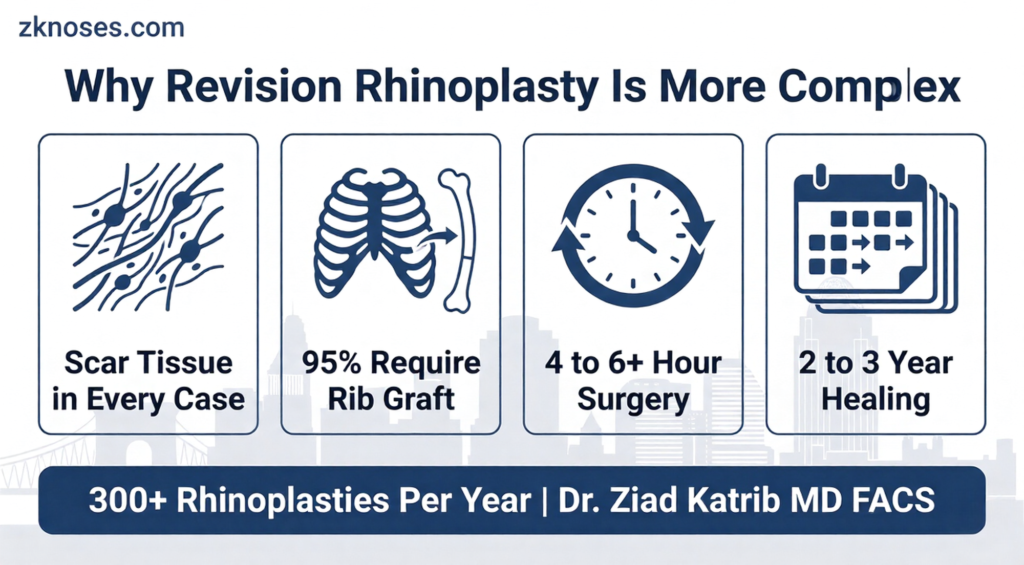
Every revision rhinoplasty begins with scar tissue. It is present in every single case without exception and it alters the anatomy in ways that cannot be fully predicted from the outside. It complicates dissection, increases bleeding risk, and makes the structures a surgeon needs to access significantly harder to reach safely.
Cartilage depletion compounds the challenge. When septal cartilage was used or removed during the original surgery, there is often little left to work with for structural rebuilding. This is why rib cartilage grafting is required in approximately 95 percent of Dr. Katrib’s revision cases. He performs over 115 rib graft harvests per year, harvesting through a small incision placed below the right breast fold. The graft provides the structural strength and volume needed for durable, long-lasting results, something most Cincinnati-based practices are not set up to offer routinely.
Operative time is significantly longer than primary rhinoplasty. Primary cases at this practice average 2 to 4 hours. Revision cases typically run 4 to 6 hours or more depending on complexity and the degree of reconstruction required. Final results take longer to emerge as well, often 2 to 3 years rather than the 12 months typical of primary rhinoplasty.
To put the volume difference in context: most Cincinnati-area surgeons perform fewer than 50 total rhinoplasty per year across both primary and revision cases. Dr. Katrib performs over 300 rhinoplasty per year, with revision cases making up a significant portion of that volume. In a procedure where experience is directly tied to outcome, that gap is substantial.
Are You a Candidate for Revision Rhinoplasty?
The single most important candidacy requirement is time. You must wait a minimum of 12 months after your primary rhinoplasty before pursuing revision surgery, and in many complex cases 18 months or longer is recommended. Scar tissue is still softening, swelling is still resolving, and the final result may still be changing during this window. Operating too early increases risk and reduces the accuracy of everything a surgeon is trying to correct.
Beyond timing, ideal candidates are in good general health and are non-smoking or willing to quit in the weeks surrounding surgery. Realistic expectations are essential. Revision rhinoplasty delivers significant functional and cosmetic improvement in the vast majority of cases but perfection is never a guaranteed outcome in any rhinoplasty procedure, primary or revision.
If you have your operative report from the original surgery, bringing it to your consultation is extremely helpful. Knowing exactly what was done, what was removed, and what was left behind allows Dr. Katrib to plan far more precisely.
Virtual Zoom consultations are available for all Cincinnati and Ohio patients, meaning you do not need to travel to Louisville until you are ready to move forward with surgery.
Dr. Katrib’s Approach to Revision Rhinoplasty
Dr. Ziad Katrib holds double board certification in both Facial Plastic Surgery and Otolaryngology (Head and Neck Surgery), the most specialized dual training available for nasal surgery. He completed his fellowship in facial plastic surgery in 2017 with a specific focus on rhinoplasty and has since built one of the highest-volume rhinoplasty practices in the country.
He performs open rhinoplasty in 98 percent of cases. In revision surgery, direct visualization of nasal structures is not optional. Working through scar tissue and altered anatomy demands the clearest possible view of everything inside the nose, and the open approach provides exactly that.
His philosophy is structural and conservative. Rebuild what has been damaged. Preserve what still works. Produce a result that looks natural and lasts. The goal is never an operated appearance. It is a nose that suits the face, functions properly, and holds up over the years.
For Cincinnati patients, the process is well established. Start with a virtual consultation. If you decide to proceed, an in-person visit the day before surgery is recommended at the Louisville practice. Roughly 95 percent of Dr. Katrib’s patients already travel from out of town and the logistics are straightforward.
Recovery After Revision Rhinoplasty
Week 1 A cast and internal splints are placed at surgery and remain in place for approximately one week. Plan for 7 to 10 days off work. Swelling and bruising peak during this phase.
Week 2 The splint comes off. Bruising clears for most patients and swelling begins to soften. Most patients feel comfortable being seen in public by the end of the second week.
Months 1 to 3 You are back to daily life. The majority of visible swelling has resolved. Subtle residual swelling remains, particularly at the tip, but is not noticeable to others.
Year 1 to 3 Final results emerge gradually. Revision rhinoplasty takes longer to fully heal than primary rhinoplasty due to the scar tissue and the degree of reconstruction involved. Patience through this phase is a genuine requirement of the procedure.
If rib cartilage was harvested, expect mild to moderate soreness at the harvest site for 1 to 4 weeks. This is the primary additional source of discomfort compared to primary rhinoplasty.
Key aftercare rules: sleep with your head elevated, avoid strenuous activity for 3 to 4 weeks, protect the nose from sun exposure, and avoid glasses resting on the bridge for 6 to 8 weeks.
Cincinnati patients receive a structured virtual follow-up schedule to keep Dr. Katrib’s team involved throughout the full recovery process between in-person visits.

Cost of Revision Rhinoplasty for Cincinnati Patients
Revision rhinoplasty at Dr. Katrib’s practice is priced at $20,000 to $40,000. This includes the surgeon’s fee, anesthesia, facility costs, and all post-operative visits.
For context, Cincinnati-based practices that offer revision rhinoplasty either hide their pricing entirely or list surgeon fees in ranges that reflect lower-volume, less specialized care. The cost of revision rhinoplasty is higher than primary rhinoplasty everywhere, and rightly so. Longer operative time, rib graft complexity, and a higher degree of technical specialization all factor into the investment.
Insurance: Cosmetic revision rhinoplasty is not covered by insurance. If there is a documented functional component such as breathing obstruction, deviated septum, or nasal valve collapse, some insurance plans will partially cover that portion with appropriate pre-authorization and medical documentation.
Financing: CareCredit financing is available in 6, 24, and 36-month terms for patients who prefer to spread the investment over time.
For Cincinnati patients weighing the travel consideration: Louisville is under two hours away by car. For a surgeon performing revision rhinoplasty at this volume and specialization level, that distance is a straightforward equation for most Ohio patients who want their result to be right.
Ready to Take the Next Step?
A poor first rhinoplasty result is not your final result. Cincinnati patients have a high-volume revision specialist less than two hours away, with virtual consultations available to get started without making the drive.
Schedule a Zoom consultation, review your goals with Dr. Katrib directly, and get a clear surgical plan before committing to anything.
Schedule your consultation at Consult or call 502.445.9311
Virtual and in-person consultations available. Serving Cincinnati OH, Mason OH, Blue Ash OH, Hyde Park, Kenwood, West Chester OH, Dayton OH, Northern Kentucky, and patients across Ohio.
General FAQs
How long must I wait before revision rhinoplasty?
A minimum of 12 months after your primary rhinoplasty, and often 18 months or longer for more complex cases. Scar tissue is still softening and swelling still resolving during this window. Consulting a specialist at the 12-month mark is reasonable even if surgery is scheduled several months later.
Can I consult with Dr. Katrib virtually from Cincinnati?
es. Virtual Zoom consultations are the standard first step for all out-of-town patients. A nominal consultation fee applies and is credited toward the surgeon’s fee if you proceed with surgery.
Does insurance cover revision rhinoplasty in Ohio?
Cosmetic revision is not covered. If there is a documented functional component affecting breathing, some insurance plans may partially cover that element. This is evaluated case by case and requires pre-authorization and documentation from your physician.
What makes Dr. Katrib different from Cincinnati revision surgeons?
Volume and rib graft capability. Dr. Katrib performs over 300 rhinoplasty per year, performs rib cartilage grafting in 95 percent of revision cases, and holds double board certification in both Facial Plastic Surgery and Otolaryngology. Most Cincinnati-area surgeons perform fewer than 50 total rhinoplasty per year and do not routinely offer rib grafting for revision cases.