 Skip to content
When you’re considering rhinoplasty, one of the most important decisions your surgeon will make is choosing between open and closed rhinoplasty techniques. While both approaches can achieve beautiful, natural-looking results, they differ significantly in how the surgery is performed, what they allow the surgeon to see and access, and how they affect your recovery and scarring.
Understanding the difference between open and closed rhinoplasty helps you have informed discussions with your surgeon, set realistic expectations, and feel confident about your surgical plan. This comprehensive guide breaks down everything you need to know about both techniques, including their advantages, limitations, and which approach might be best for your specific nose and goals.
The truth is, there’s no universally “better” technique. The right choice depends on your nasal anatomy, the complexity of changes you’re seeking, your surgeon’s expertise, and your personal concerns about scarring and recovery. Let’s explore both approaches in detail so you can understand which technique your surgeon might recommend and why.
What Is Open Rhinoplasty?
The Basics of Open Approach
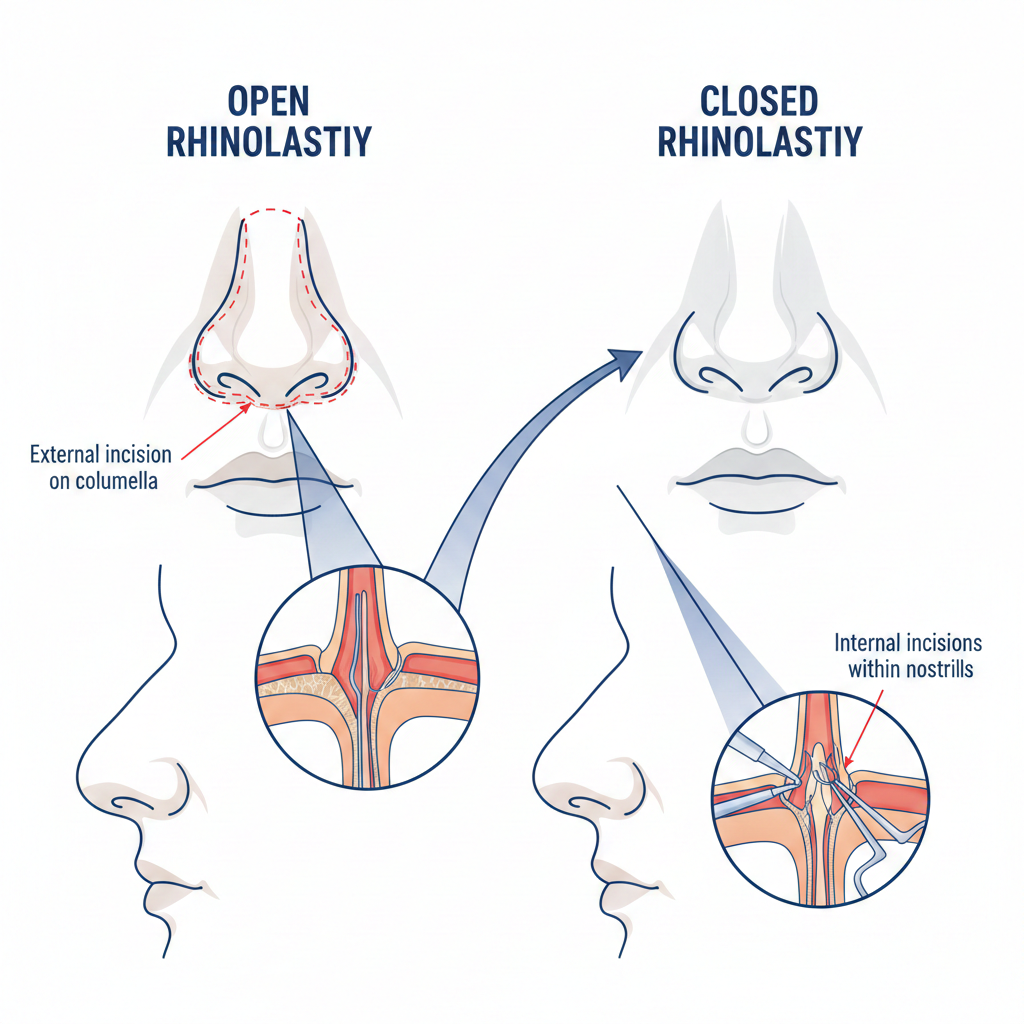
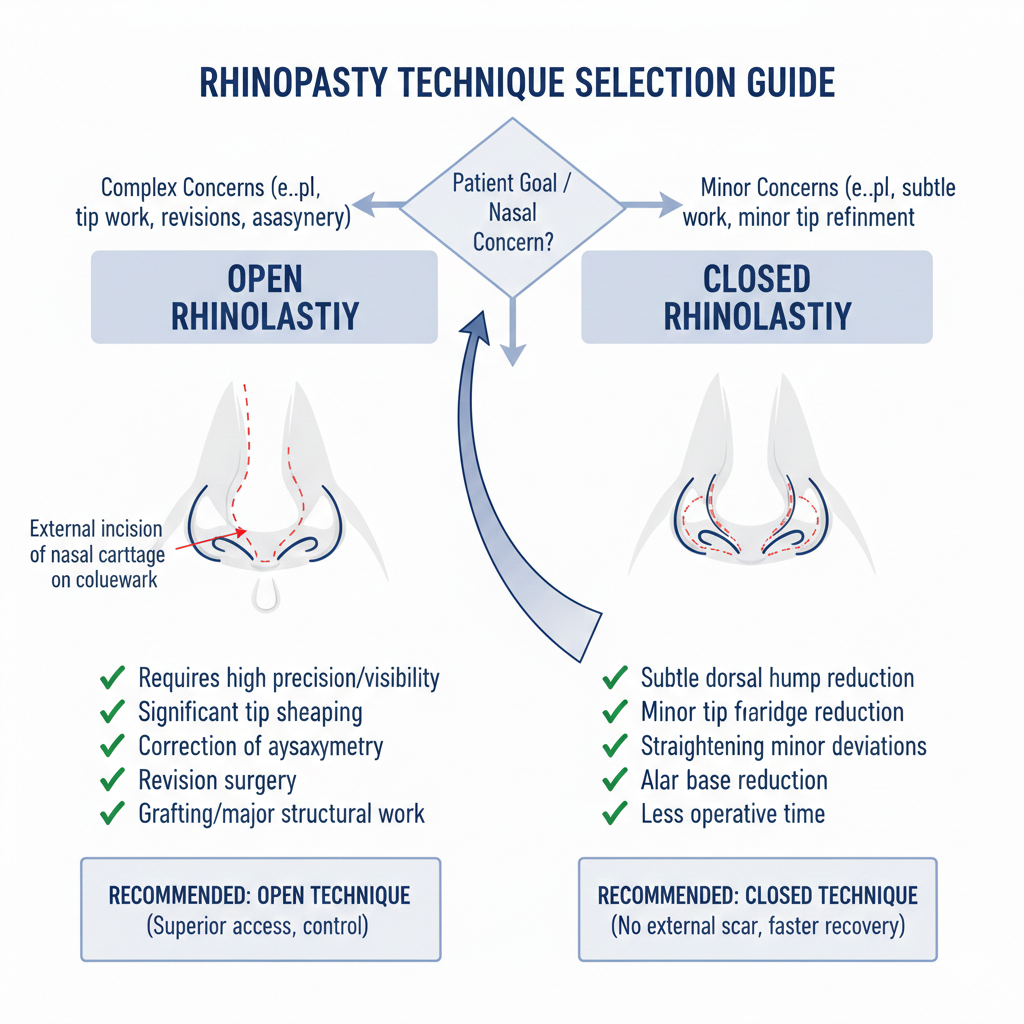
Open rhinoplasty, also called external rhinoplasty, is a surgical technique where the surgeon makes a small incision across the columella, which is the narrow strip of tissue that separates your nostrils. This external incision is then connected to incisions inside both nostrils, allowing the surgeon to lift the skin of the nose upward like opening a hood on a car.
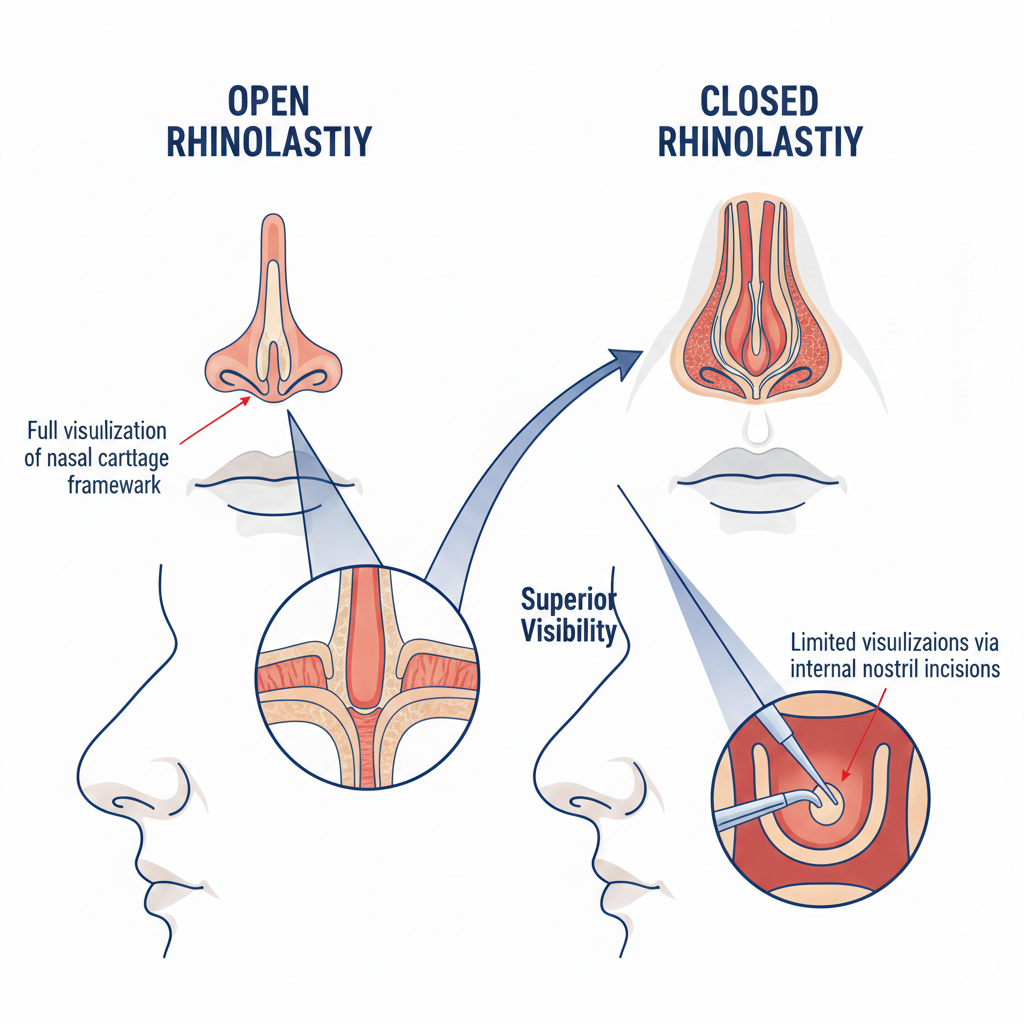
This approach provides direct, unobstructed visualization of the nasal structures. Think of it as having the entire nasal framework exposed and visible under bright surgical lighting, allowing the surgeon to see exactly what they’re working with and make precise modifications to both bone and cartilage.
The Surgical Process
During open rhinoplasty, your surgeon begins by making a small incision (typically 4 to 5 millimeters) across the columella in a zigzag or stepped pattern. This careful incision placement in the natural crease helps minimize visible scarring. Additional incisions are made inside the nostrils, connecting to the external incision.
The skin covering the nose is then carefully elevated and pulled upward, exposing the underlying cartilage and bone structure. This gives the surgeon a complete, three-dimensional view of your nasal anatomy. All modifications to cartilage, bone, and internal structures are performed under direct vision, meaning the surgeon can see exactly what they’re doing at every moment.
Once all reshaping is complete, the skin is carefully redraped over the new structure, and the incisions are closed with very fine sutures. The columellar incision is closed with meticulous attention to achieving an imperceptible scar.
When Open Rhinoplasty Is Used
Open rhinoplasty has become increasingly popular and is now used in approximately 60 to 70% of all rhinoplasty procedures. It’s particularly favored for:
Complex Cases: When significant reshaping is needed, such as reducing a large hump, extensively refining the tip, or correcting severe asymmetry.
Revision Rhinoplasty: When operating on a nose that’s been previously operated on, the direct visualization is invaluable for navigating scar tissue and understanding the altered anatomy.
Structural Grafting: When cartilage grafts are needed to support or augment the nose, precise placement is easier with full visibility.
Teaching Purposes: In academic medical centers, open rhinoplasty allows training surgeons to see and learn from the procedure more effectively.
Predictability: Many surgeons feel that open rhinoplasty allows for more predictable, precise results, especially in complex cases.
Surgeon’s Perspective
From a technical standpoint, open rhinoplasty offers several advantages to the surgeon. The complete exposure allows for detailed assessment of the nasal framework, precise placement of sutures and grafts, better understanding of asymmetries, and the ability to make adjustments under direct vision rather than by feel.
Many experienced rhinoplasty surgeons prefer open rhinoplasty for most cases because it removes the guesswork. They can see the cartilage’s shape, strength, and position, allowing them to make informed decisions about how much to remove, reshape, or reinforce.
What Is Closed Rhinoplasty?
The Basics of Closed Approach
Closed rhinoplasty, also called endonasal rhinoplasty, is a surgical technique where all incisions are made inside the nostrils. There is no external incision on the columella, meaning there will be no visible external scar. The entire procedure is performed through the nostril openings, with the surgeon working “blindly” or with limited direct visualization.
Instead of lifting the skin to expose the nasal framework, the surgeon works through small openings inside the nose, using specialized instruments and their extensive knowledge of nasal anatomy to feel and reshape the structures. It requires significant surgical skill and experience.
The Surgical Process
During closed rhinoplasty, your surgeon makes incisions inside your nostrils, typically along the inner lining. These incisions are completely hidden and invisible to anyone looking at you. Through these small openings, the surgeon inserts instruments to access the bone and cartilage.
The surgeon works by a combination of direct vision (looking into the nostril openings with specialized lighting), palpation (feeling the structures through the skin), and extensive anatomical knowledge. Modifications are made to the nasal bones and cartilage through these limited access points.
Because the skin is not lifted off the underlying structures, the nose maintains more of its natural connections and blood supply during surgery. Once reshaping is complete, the internal incisions are closed with dissolvable sutures that you’ll never see.
When Closed Rhinoplasty Is Used
Closed rhinoplasty is typically chosen for less complex cases where excellent results can be achieved without the need for extensive exposure. It’s particularly appropriate for:
Minor Refinements: Small adjustments to the nasal bridge, subtle tip modifications, or minor asymmetry corrections.
Reduction Rhinoplasty: When the goal is primarily to reduce size or remove a hump rather than extensive reconstruction.
Straightforward Cases: Patients with good nasal anatomy requiring predictable, standard modifications.
Patient Scar Concerns: When a patient has a history of poor scarring or is particularly anxious about any external scar.
Experienced Surgeons: Surgeons who trained primarily in closed techniques and have extensive experience with this approach.
Surgeon’s Perspective
Closed rhinoplasty requires advanced technical skill because the surgeon must work with limited visualization. It’s like being a master craftsman who can create beautiful work even when they can’t see every detail. The surgeon relies heavily on their three-dimensional understanding of nasal anatomy, tactile feedback, and years of experience.
Some surgeons strongly prefer closed rhinoplasty when appropriate because it respects the natural tissue planes, preserves blood supply more effectively, and avoids any external incision. However, they also recognize its limitations and will choose open rhinoplasty when the case complexity demands it.
Key Differences: Open vs Closed Rhinoplasty
Incision Location and Visibility
Open Rhinoplasty: One small external incision across the columella (4 to 5mm) plus internal nostril incisions. The external incision is visible immediately after surgery but fades significantly over 6 to 12 months. Most scars become nearly invisible within a year.
Closed Rhinoplasty: All incisions are inside the nostrils, completely hidden from external view. No visible scars at any point in recovery. This is the primary advantage that makes some patients and surgeons prefer this approach.
Surgical Exposure and Visualization
Open Rhinoplasty: Provides complete, direct visualization of the entire nasal framework. The surgeon can see all cartilage and bone structures under bright, direct lighting. It’s like working with the lights on in a well-lit room.
Closed Rhinoplasty: Provides limited, indirect visualization through nostril openings. The surgeon works more by feel and experience, with limited direct sight lines. It’s like working in a dimly lit room where you must rely more on touch and memory.
Degree of Control and Precision
Open Rhinoplasty: Allows for extremely precise modifications because the surgeon can see exactly what they’re doing. Sutures can be placed with millimeter accuracy. Grafts can be positioned and secured under direct vision. Asymmetries can be directly observed and corrected.
Closed Rhinoplasty: Requires the surgeon to work more by feel, though experienced surgeons achieve excellent precision through years of practice. Some very delicate adjustments may be more challenging without direct visualization.
Surgical Time
Open Rhinoplasty: Typically takes 30 to 45 minutes longer than closed rhinoplasty due to the time needed to make the columellar incision, elevate the skin, and close the external incision carefully at the end.
Closed Rhinoplasty: Generally faster because there’s no external incision to make or close. The entire procedure is accomplished through existing nostril openings. However, complex cases may take longer due to the technical difficulty of working with limited access.
Swelling Patterns
Open Rhinoplasty: Tends to cause slightly more swelling, particularly in the nasal tip, because the skin is completely elevated from the underlying structures. The disruption to blood vessels and lymphatic drainage is more extensive.
Closed Rhinoplasty: Generally results in somewhat less swelling because the tissue planes are less disrupted and more natural blood supply is preserved. However, the difference is modest, and both approaches result in significant swelling that takes months to fully resolve.
Revision Rates
Open Rhinoplasty: Some studies suggest slightly lower revision rates for complex cases because the increased visibility allows for more precise corrections during the initial surgery.
Closed Rhinoplasty: May have slightly higher revision rates in complex cases, though this depends heavily on surgeon experience. For straightforward cases in experienced hands, revision rates are comparable.
Pros and Cons: Detailed Comparison
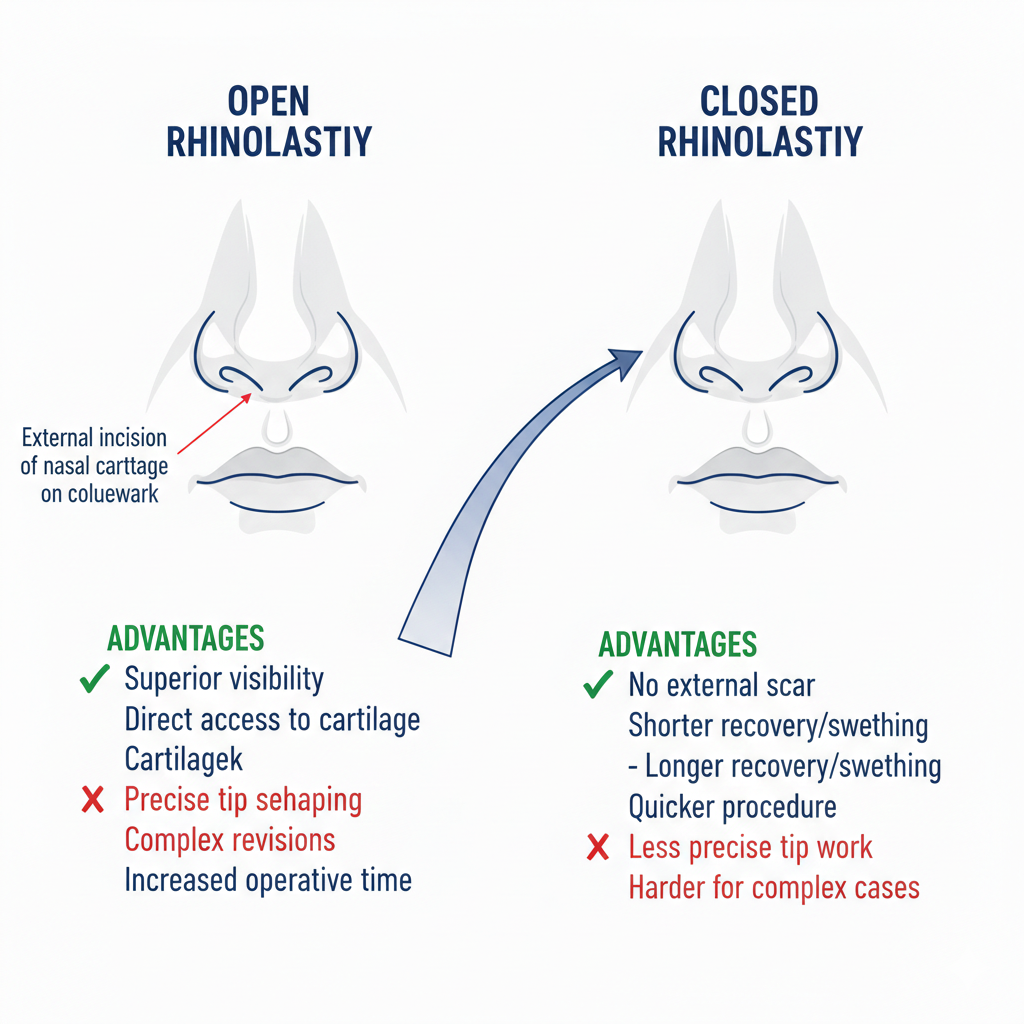
Open Rhinoplasty Advantages
Superior Visualization: This is the primary advantage. The surgeon can see everything clearly, allowing for more accurate assessment and modification. It’s particularly valuable when dealing with complex anatomy, significant asymmetries, or revision cases where the anatomy may be distorted.
Greater Precision: With direct vision, the surgeon can place grafts, sutures, and make modifications with millimeter accuracy. This is especially important for delicate tip work where small adjustments make significant aesthetic differences.
Educational Value: For patients, knowing their surgeon can see everything clearly may provide peace of mind. For training surgeons, open rhinoplasty allows better learning of three-dimensional anatomy.
Better for Complex Cases: When extensive reshaping, multiple grafts, or correction of severe problems is needed, open rhinoplasty provides the access and control necessary for optimal results.
Easier Problem-Solving: If the surgeon encounters unexpected findings during surgery (unusual anatomy, more severe deviation than anticipated), they can better assess and address issues with full visualization.
More Predictable Results: Many surgeons feel they can achieve more consistent, predictable outcomes with open rhinoplasty, especially for challenging cases.
Open Rhinoplasty Disadvantages
External Scar: The columellar scar is the primary disadvantage. While most scars heal beautifully and become nearly invisible, some patients develop more noticeable scarring. People with darker skin or a history of keloid scarring may be at higher risk for visible scarring.
More Swelling: The greater tissue disruption typically results in more swelling, particularly in the tip. This may prolong the time until you see your final result, especially if you have thick skin.
Longer Surgery Time: The additional steps of making the columellar incision, elevating skin, and carefully closing at the end add 30 to 45 minutes to the procedure. This means slightly more time under anesthesia.
Slightly Longer Recovery: Some patients report that the first week feels slightly more uncomfortable with open rhinoplasty, though this is debated and may depend on individual factors.
Tip Numbness: There may be slightly more tip numbness that takes longer to resolve compared to closed rhinoplasty, though both approaches can cause temporary numbness.
Closed Rhinoplasty Advantages
No External Scar: This is the primary advantage. All scars are hidden inside the nostrils where no one can see them. For patients who are particularly concerned about scarring or who have risk factors for poor scarring, this is significant.
Less Swelling: Preserving more natural tissue planes and blood supply typically results in somewhat less swelling, particularly in the tip. This may allow you to see your results slightly sooner.
Faster Procedure: Without the need to make and close an external incision, the surgery is typically 30 to 45 minutes shorter. Less time under anesthesia may reduce nausea and grogginess afterward.
Faster Initial Recovery: Some patients report feeling slightly better in the first week, though the overall recovery timeline is very similar to open rhinoplasty.
Natural Tissue Planes: Working within the natural layers of the nose may preserve more blood supply and lymphatic drainage, potentially aiding healing.
Closed Rhinoplasty Disadvantages
Limited Visualization: The surgeon must work with restricted views and rely heavily on tactile feedback and experience. This can make complex modifications more challenging.
Technically Demanding: Closed rhinoplasty requires exceptional surgical skill and extensive experience. Not all surgeons are equally proficient in this technique, and it’s not commonly taught in many training programs.
Less Suitable for Complex Cases: Revision rhinoplasty, severe asymmetries, extensive tip work, or cases requiring multiple grafts are often better served by open rhinoplasty.
Less Precise Control: While experienced surgeons achieve excellent results, the limited access can make some very delicate adjustments more difficult.
Steeper Learning Curve: For surgeons, closed rhinoplasty takes longer to master. The number of surgeons highly skilled in closed rhinoplasty is smaller than those proficient in open techniques.
Which Technique for Which Nose Type?
Open Rhinoplasty Is Usually Best For:
Complex Tip Work: If you need significant tip refinement, rotation, or projection changes, open rhinoplasty provides the access needed for precise modifications. This includes making a bulbous tip more refined, lifting a drooping tip, or correcting tip asymmetries.
Revision Rhinoplasty: If you’ve had previous nose surgery, scar tissue and altered anatomy make direct visualization invaluable. Most revision rhinoplasties are performed using the open technique because understanding what was done before and what needs correction requires seeing the structures clearly.
Significant Asymmetry: When one side of your nose is noticeably different from the other, whether from injury or natural development, seeing both sides simultaneously helps the surgeon create symmetry.
Extensive Structural Work: If your procedure requires multiple cartilage grafts (from your septum, ear, or rib) to build support or augment your nose, precise graft placement is easier with full visualization.
Crooked or Deviated Noses: Straightening a significantly crooked nose often requires osteotomies (controlled bone breaks) and cartilage adjustments that benefit from direct visualization.
Cleft Lip Rhinoplasty: Patients with a history of cleft lip repair often have complex nasal anatomy that is best addressed with open rhinoplasty.
Ethnic Rhinoplasty Requiring Augmentation: When building up a low nasal bridge or adding projection, placing augmentation grafts precisely is important for natural-looking results.
Wide or Bulbous Noses: Significant reduction and reshaping of thick skin and cartilage often requires the precision that open rhinoplasty provides.
Closed Rhinoplasty Is Usually Best For:
Dorsal Hump Reduction: If your primary concern is removing a bump on your nasal bridge without significant tip work, closed rhinoplasty can achieve excellent results with no external scar.
Minor Tip Refinement: Small adjustments to tip projection or rotation, without complex restructuring, can often be accomplished through nostril incisions.
Straightforward Reductions: When you simply want to make your nose smaller without complex reshaping, closed rhinoplasty may be ideal.
Nostril Reduction: Narrowing wide nostrils (alar base reduction) can be performed through hidden incisions, often combined with closed rhinoplasty for other changes.
Young Patients with Good Anatomy: Patients with favorable nasal anatomy requiring standard modifications are often excellent candidates for closed rhinoplasty.
Patients with Keloid History: If you have a history of thick, raised scars, avoiding an external incision eliminates concern about a visible columellar scar.
Minor Asymmetry: Small irregularities that don’t require extensive restructuring can often be addressed through closed techniques.
Thin-Skinned Patients: With thin skin, results are visible sooner, and the limited exposure of closed rhinoplasty is often sufficient.
Cases Where Either Technique Works:
Moderate Tip Refinement: Some tip modifications can be achieved with either approach, depending on surgeon preference and experience.
Septoplasty Combined with Cosmetic Changes: Correcting a deviated septum while making minor cosmetic improvements can often use either technique.
Nasal Bridge Narrowing: Making a wide bridge narrower through osteotomies can be accomplished with either approach.
Mild Asymmetries: Minor unevenness can be corrected using either open or closed techniques.
Your Surgeon’s Expertise Matters Most
Here’s a crucial point: your surgeon’s experience and preference with a particular technique often matters more than theoretical advantages. A surgeon who is exceptionally skilled in closed rhinoplasty may achieve better results using that approach than a less experienced surgeon using open rhinoplasty, even if open would theoretically provide advantages.
Ask your surgeon:
- “Which technique do you use most often and why?”
- “How many rhinoplasties have you performed using each technique?”
- “Which approach do you recommend for my specific case and why?”
- “What are your revision rates with each technique?”
A surgeon should be able to explain clearly why they’re recommending a particular approach for your nose and goals.
Recovery Differences: What to Expect
Immediate Post-Operative Period (Days 1-3)
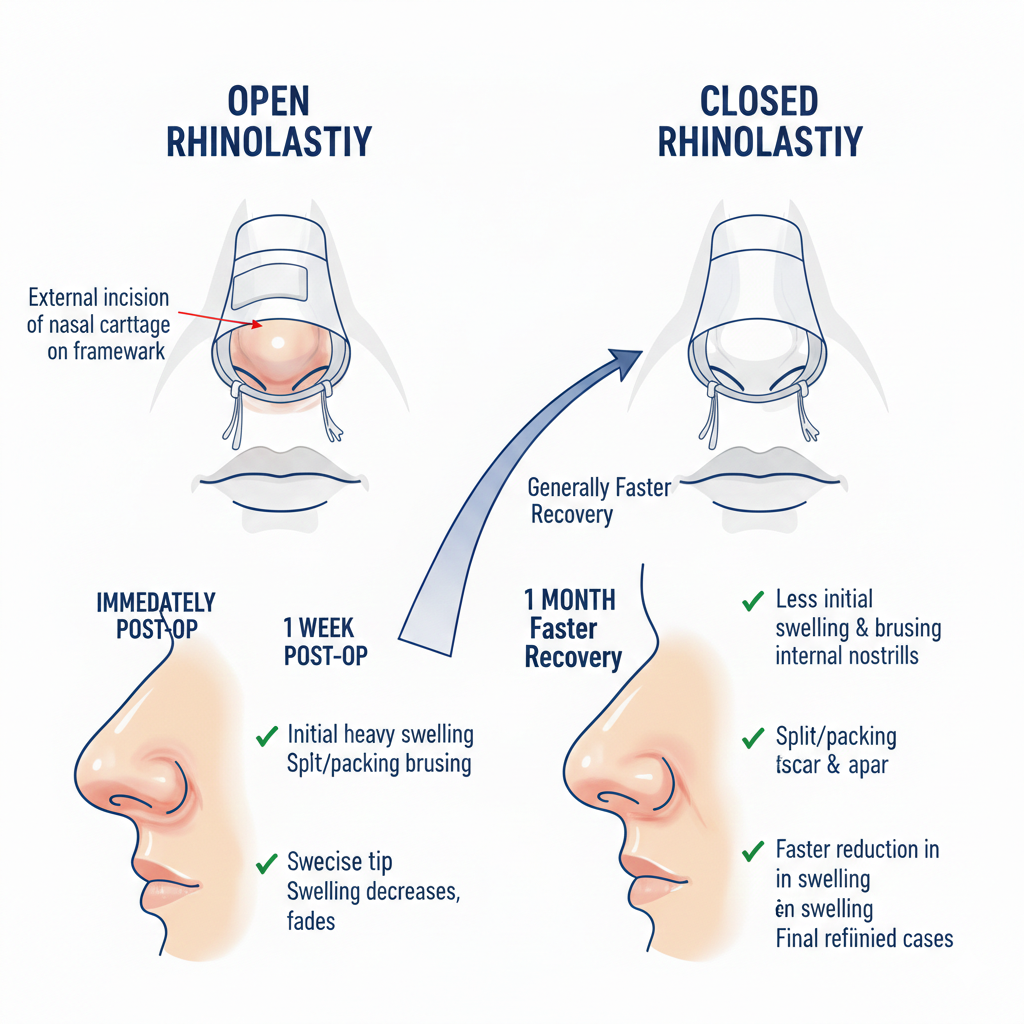
Open Rhinoplasty: You’ll have an external splint, internal packing or splints, and possibly more swelling around the tip. The columellar incision is closed with tiny sutures that may be visible but are covered by the external splint. Discomfort is typically manageable with prescribed pain medication.
Closed Rhinoplasty: You’ll have an external splint and possibly internal splints, but no external sutures to worry about. Swelling may be slightly less pronounced. Discomfort levels are similar to open rhinoplasty and well-controlled with medication.
Key Similarity: Both approaches require sleeping elevated, avoiding nose-blowing, and managing swelling with ice packs. The first few days feel very similar regardless of technique.
First Week (Days 4-7)
Open Rhinoplasty: When your splint is removed (typically day 5 to 7), you’ll see the columellar incision for the first time. It will be red and slightly raised, which is normal. Some patients have external sutures removed at this appointment, while others have dissolvable sutures. The tip appears very swollen.
Closed Rhinoplasty: Splint removal reveals no external incisions or sutures. You may feel you look slightly less swollen than open rhinoplasty patients at this stage, though both approaches show significant swelling.
Key Difference: The presence or absence of a visible external incision. Open rhinoplasty patients must care for the columellar incision and watch it heal, while closed rhinoplasty patients have no external wound to monitor.
Weeks 2-4
Open Rhinoplasty: The columellar scar is visible but healing. It may be slightly pink or red. Tip swelling remains significant and may even seem worse at certain times of day (morning puffiness is common). Most bruising has faded. You can return to work and social activities but may be self-conscious about the incision line.
Closed Rhinoplasty: No external scar to worry about. Tip swelling is present but may be slightly less than open rhinoplasty. You can return to all normal activities with no concerns about visible healing incisions.
Key Difference: The psychological factor of having a visible healing scar with open rhinoplasty versus no external signs of surgery with closed rhinoplasty.
Months 2-6
Open Rhinoplasty: The columellar scar continues fading and becoming less noticeable. By month 3, most scars are significantly improved. Tip swelling gradually decreases but may take longer to fully refine compared to closed rhinoplasty, especially if you have thick skin.
Closed Rhinoplasty: No scar concerns at all. Tip swelling resolves at a similar rate to open rhinoplasty, though some patients report slightly faster tip refinement. This may be due to less tissue disruption.
Key Similarity: Both approaches require patience as swelling slowly resolves over many months. The final result timeline is very similar.
Months 6-12: Final Results
Open Rhinoplasty: The columellar scar should be barely visible or invisible by 12 months in most patients. Some patients with darker skin or poor healing may have a slightly visible fine line, but it’s typically very subtle. Final tip refinement is complete or nearly complete.
Closed Rhinoplasty: No scar to evaluate. Final tip shape is fully refined. Both approaches typically reach their final result around the same time, though some surgeons feel closed rhinoplasty patients may see final refinement slightly sooner.
Key Similarity: At one year post-op, most observers cannot tell which technique was used just by looking at the nose. Both approaches, when performed skillfully, achieve natural, beautiful results.
Recovery Timeline Comparison Table
| Recovery Milestone | Open Rhinoplasty | Closed Rhinoplasty |
|---|---|---|
| Surgery Time | 2-3.5 hours | 1.5-3 hours |
| Splint Removal | Day 5-7 | Day 5-7 |
| External Sutures | Removed or dissolve by day 7 | None |
| Return to Work | Week 1-2 | Week 1-2 |
| Light Exercise | Week 2-3 | Week 2-3 |
| Bruising Fades | 2-3 weeks | 2-3 weeks |
| Major Swelling Down | 3-4 weeks | 3-4 weeks |
| Social Comfort | Week 2-3 (once scar less visible) | Week 1-2 |
| 70% Healed | 1 month | 1 month |
| Scar Nearly Invisible | 6-12 months | N/A (no external scar) |
| Final Result | 12-18 months | 12-18 months |
Scarring Considerations: The Columellar Incision
Understanding the Scar from Open Rhinoplasty
The external scar from open rhinoplasty is typically 4 to 5 millimeters long and placed across the columella in a strategic pattern. Surgeons use several techniques to minimize scarring:
Incision Patterns: The incision is made in a stair-step, zigzag, or inverted-V pattern. This irregular pattern helps the scar blend into the natural contours of the columella and prevents a straight, obvious line.
Placement: The incision is positioned in the narrowest part of the columella, often at the junction between the columella and the lip, where natural shadowing helps hide it.
Closure Technique: Surgeons use extremely fine sutures (often 6-0 or 7-0, which are thinner than a human hair) and close the incision in multiple layers to minimize tension on the skin.
Scar Healing Timeline
Week 1: The incision is red, slightly raised, and obvious. It’s covered by your external splint for most of the week.
Weeks 2-4: The incision line is visible but healing. It may be pink or red and slightly raised. This is the phase where patients are most concerned about the scar.
Months 2-3: Significant fading occurs. The scar becomes flatter and lighter in color. Most patients notice dramatic improvement during this period.
Months 6-12: Continued fading and flattening. Most scars become barely visible or completely invisible by one year.
Long-term: In the vast majority of patients, the scar is imperceptible from a normal social distance (3 to 5 feet away). Even up close, most scars are very difficult to see.
Factors Affecting Scar Quality
Skin Type: People with lighter skin tones typically develop less visible scars. Those with darker skin or skin prone to hyperpigmentation may develop slightly more noticeable scars, though proper technique and scar care minimize this.
Genetics: Some people are genetically predisposed to excellent scar healing, while others form thicker or more visible scars. Your history with other scars can give clues about how you’ll heal.
Surgeon Technique: A skilled surgeon who takes care in making the incision in the optimal location, closing it meticulously in layers, and avoiding tension produces better scars.
Sun Exposure: Protecting the scar from sun for the first 6 to 12 months prevents hyperpigmentation (darkening) and ensures optimal fading. Always use SPF 30+ sunscreen on your nose.
Smoking: Smoking impairs healing and increases the risk of poor scarring. All patients should avoid smoking for at least 4 weeks before and after surgery.
Scar Care: Following your surgeon’s scar care instructions, which may include silicone gel, massage, or other treatments, improves scar quality.
Scar Revision Options
In the rare event that your columellar scar is more visible than desired after a year of healing, several options exist:
Steroid Injections: For raised or thickened scars, tiny injections of corticosteroid can flatten the scar.
Laser Treatments: Various laser therapies can improve scar color, texture, and visibility.
Scar Revision Surgery: In very rare cases, the scar can be surgically revised, though most scars don’t require this.
The Reality of Scarring
Here’s the honest truth: in the hands of an experienced rhinoplasty surgeon, over 90% of open rhinoplasty patients have scars that are essentially invisible from a normal social distance. Many patients forget they even have a scar. Even when looking closely in the mirror, most patients struggle to find their columellar scar after a year of healing.
The small risk of a barely visible fine line is, for most patients and surgeons, worth the advantages that open rhinoplasty provides in terms of surgical precision and visualization. However, if the idea of any external scar, no matter how small or invisible, causes you significant anxiety, closed rhinoplasty may be the better choice for you, assuming your case is appropriate for that technique.
Making Your Decision: Questions to Ask Your Surgeon
Essential Questions
1. Which technique do you recommend for my nose and why?
Your surgeon should be able to explain specific anatomical reasons why they’re suggesting open or closed rhinoplasty for your case. Generic answers like “I always use open” or “I prefer closed” without case-specific reasoning aren’t sufficient.
2. What percentage of your rhinoplasties use each technique?
This tells you about the surgeon’s experience and comfort level with each approach. Many modern rhinoplasty surgeons use open technique for 60 to 80% of cases, but experienced surgeons should be proficient in both.
3. Can I see before and after photos of patients with similar noses using the technique you’re recommending?
Seeing results in patients who had similar concerns and the same technique helps set realistic expectations.
4. What are the specific advantages of your recommended technique for my goals?
The surgeon should connect the technique choice to your specific aesthetic or functional goals.
5. What are the risks or disadvantages of the technique you’re recommending?
A good surgeon is honest about potential downsides and doesn’t oversell one technique as perfect.
6. If I’m concerned about the columellar scar, can you still achieve my goals with closed rhinoplasty?
Understanding whether closed rhinoplasty is a viable option for your case is important if scarring is a major concern.
7. Can you show me examples of your columellar scars in open rhinoplasty patients?
If open rhinoplasty is recommended and you’re worried about scarring, seeing how this surgeon’s scars heal is valuable.
Red Flags
Be cautious if your surgeon:
- Insists one technique is always superior without explaining why it’s best for your specific case
- Cannot explain the differences between open and closed rhinoplasty clearly
- Shows little experience with one technique or the other
- Dismisses your concerns about scarring without addressing them thoughtfully
- Seems defensive when you ask about their technique preference and experience
Trust Your Surgeon’s Recommendation
After asking your questions and understanding the reasoning, trust your surgeon’s recommendation. They’re assessing factors you can’t see in a mirror: your cartilage strength and configuration, your skin thickness, the degree of asymmetry, the complexity of changes needed, and their own surgical capabilities.
A surgeon recommending open rhinoplasty isn’t necessarily taking the “easy way out.” They may be recommending the approach that gives you the best chance at achieving your goals with precision and safety. Conversely, a surgeon recommending closed rhinoplasty isn’t necessarily being conservative; they may recognize that your case is ideal for this approach and that you’ll benefit from no external scar.
Final Thoughts
The debate between open and closed rhinoplasty isn’t about one technique being universally superior. Both approaches, in skilled hands, consistently produce natural, beautiful results that last a lifetime. The “best” technique is the one that:
- Matches your anatomy and goals: Complex cases benefit from open rhinoplasty’s visualization; straightforward cases may be ideal for closed rhinoplasty’s scar-free approach.
- Aligns with your surgeon’s expertise: An exceptionally skilled surgeon using their preferred technique will achieve better results than a less experienced surgeon using the theoretically “better” technique for your case.
- Addresses your concerns: If you have significant anxiety about any visible scar, closed rhinoplasty may provide peace of mind (assuming your case allows for it).
- Provides the precision needed: If your goals require millimeter-level precision in tip work or graft placement, open rhinoplasty’s visualization may be essential.
The most important factors in your rhinoplasty success are choosing a qualified, experienced, board-certified surgeon who specializes in rhinoplasty; having clear, realistic goals; following pre- and post-operative instructions carefully; and being patient during the healing process.
Whether your surgeon uses an open or closed approach, the technique is simply a tool to achieve your goal: a nose that enhances your facial harmony, looks natural, functions well, and makes you feel confident. Focus on finding the right surgeon first, then trust their judgment about which technique will serve you best.