TL;DR
Rhinoplasty before and after expectations are one of the most misunderstood parts of the entire process. Most patients assume the dramatic transformation they see in marketing photos happens within a few weeks. In reality, true rhinoplasty results timeline unfolds over a full year, with the most significant visible changes happening between months three and twelve. Rhinoplasty Indianapolis | Dr. Ziad Katrib patients are walked through this exact timeline during consultation, because understanding it prevents the disappointment that comes from comparing your week 2 result to someone else’s final photo.
You scroll through a surgeon’s gallery, find a result you love, and assume that is roughly what you will look like a few weeks after your own surgery. Then your own week two arrives, and the mirror shows you something that looks nothing like that photo, and panic sets in.
This is one of the most common and most avoidable sources of post-surgical anxiety. According to the American Society of Plastic Surgeons 2023 statistics report, rhinoplasty patient satisfaction is closely tied to how well expectations were set before surgery, not just the technical outcome itself. Whether you are comparing rhinoplasty cost Indianapolis, rhinoplasty cost Lexington KY, or rhinoplasty cost Cincinnati, this is the piece that explains what you are actually paying for in terms of timeline, not just price.
Why Results Develop Over Time
The nose is made up of skin, cartilage, and bone, all of which respond differently to surgical trauma and heal at different speeds. Bone and cartilage settle relatively quickly. Skin and the soft tissue layer underneath take dramatically longer to fully retract and reveal the final structural shape underneath.
Natural rhinoplasty results, the kind that look like they were never operated on, require this full settling process to complete. Rushing to judge a result before the swelling has resolved is one of the most common sources of unnecessary post-surgical anxiety.
What Your Nose Looks Like at 1 Week Through 1 Year
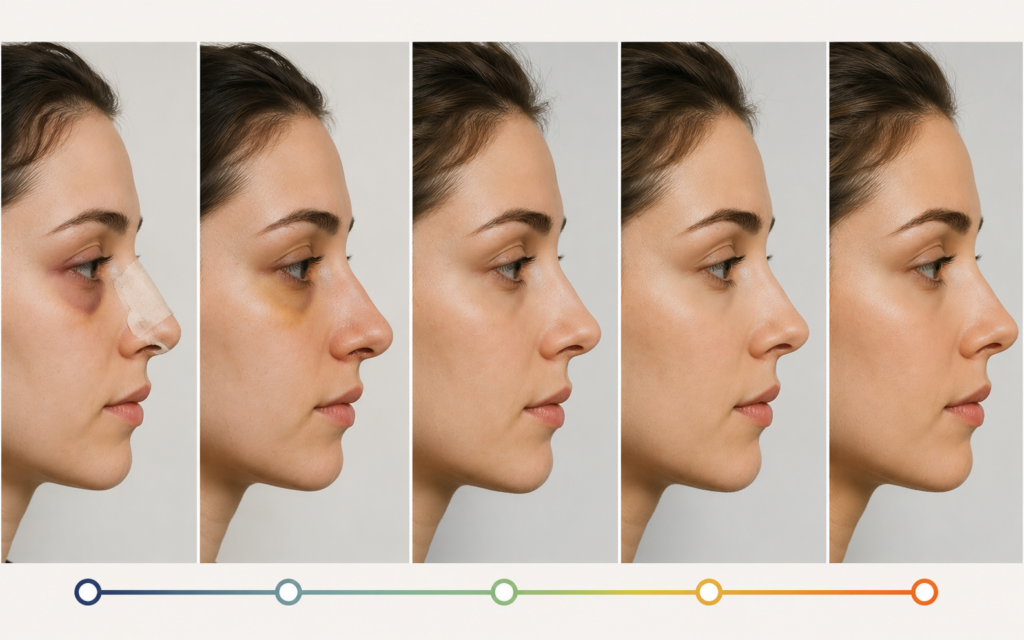
Here is a realistic, stage by stage breakdown of the rhinoplasty results timeline:
- Week 1: The nose is covered by a cast or splint. Significant bruising and swelling around the eyes is common. This is not representative of the final result in any way.
- Weeks 2 to 4: The cast comes off, revealing a nose that is still noticeably swollen, particularly at the tip and bridge. Most patients feel discouraged at this stage because the shape does not yet resemble what was discussed in consultation.
- Months 2 to 3: Swelling reduces significantly. Many patients feel comfortable returning to social situations without noticing obvious post-surgical changes from others.
- Months 6 to 12: The tip, which holds onto swelling the longest due to its thicker skin and more delicate cartilage work, gradually refines and reveals its true final shape.
What Makes a Result Look Natural
A natural rhinoplasty result is one where the changes are visible but the surgery itself is not obvious. This requires careful preservation of the patient’s underlying facial proportions and skin characteristics rather than imposing a standardized shape onto every patient.
Dr. Katrib’s preservation rhinoplasty approach prioritizes maintaining as much of the natural anatomy as possible, which tends to produce results that settle into a more natural final appearance compared to techniques that remove and rebuild more aggressively.
Swelling: Why It Takes So Long
Rhinoplasty swelling healing is slower than most other facial procedures because the nasal tip has thicker, less elastic skin and a denser network of tiny blood vessels compared to other areas of the face. This combination means fluid takes longer to fully drain and the soft tissue takes longer to fully contract around the new cartilage framework underneath.
Patients with thicker skin generally experience a longer swelling resolution timeline than patients with thinner skin, which is part of why Dr. Katrib’s consultation process includes a direct assessment of skin thickness when setting realistic expectations.
Evaluating Before and After Photos
When reviewing rhinoplasty studio photos from any surgeon’s gallery, here is what to actually pay attention to:
Check whether the “after” photo is labeled with a specific timeframe. Photos taken at 2 weeks tell you very little about the final result.
Look for multiple angles, not just a single flattering front view
Compare cases with similar skin thickness and ethnicity to your own anatomy when possible
Ask the surgeon directly how long after surgery their gallery photos were taken
Realistic rhinoplasty expectations are built on understanding that the photo you are looking at, if taken too early, may not reflect what that same patient looks like a year later.
Conclusion
The gap between what patients expect to see in the mirror at two weeks and what they actually see is one of the most common sources of post-surgical regret, and it is almost entirely preventable with the right expectations set in advance.
Here is what matters most:
- The full rhinoplasty results timeline unfolds over approximately 12 months
- Early swelling, particularly at the tip, is normal and not representative of the final outcome
- Skin thickness directly affects how long swelling takes to resolve
- When evaluating before and after galleries, always check the timeframe of the “after” photo
Dr. Ziad Katrib, MD walks every patient through this exact timeline during consultation so there are no surprises after surgery. Understanding what to expect at each stage is part of what makes the recovery process feel manageable rather than alarming.
The consultation is $300, available virtually or in person. Call 502-445-9311 or visit ZKNoses.com to book yours.
Frequently Asked Questions
When will I see my final rhinoplasty result?
Most patients see a result close to final between months 6 and 12, with the nasal tip typically being the last area to fully settle due to thicker skin and more delicate cartilage work in that area.
Why does my nose still look swollen a few months after surgery?
Swelling resolves gradually over approximately a year. The tip in particular retains swelling the longest due to its skin thickness and the surgical work performed there. This is a normal part of healing, not a sign that something went wrong.
Should I be worried if my nose doesn’t look like the consultation photos at 4 weeks?
No. Four weeks is far too early in the healing process to judge the final result. Most of the dramatic early swelling has not yet resolved, and the nose will continue to refine in shape over the following months.
How can I tell if a surgeon’s before and after photos are reliable?
Look for photos labeled with a specific post-surgical timeframe, ideally at least 6 to 12 months out. Photos taken at 2 to 4 weeks do not reflect the final result and should be viewed with caution.
Does skin thickness affect how long rhinoplasty swelling lasts?
Yes. Patients with thicker skin generally experience a longer swelling resolution timeline than patients with thinner skin, since thicker tissue takes longer to fully contract around the new underlying structure.