 Skip to content
What Is Rhinoplasty?
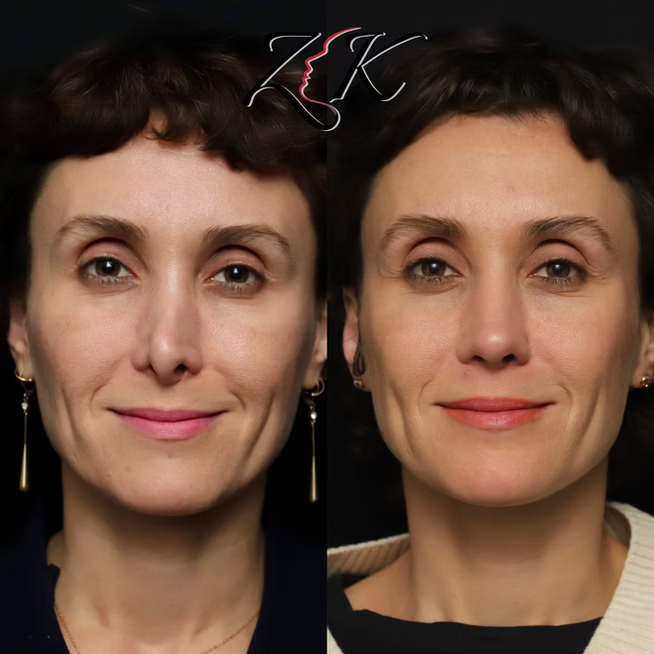
Rhinoplasty, commonly called a nose job, is a surgical procedure that reshapes, resizes, or reconstructs the nose. It’s one of the most commonly performed cosmetic surgeries worldwide, with over 352,000 procedures performed in the United States alone in 2024.
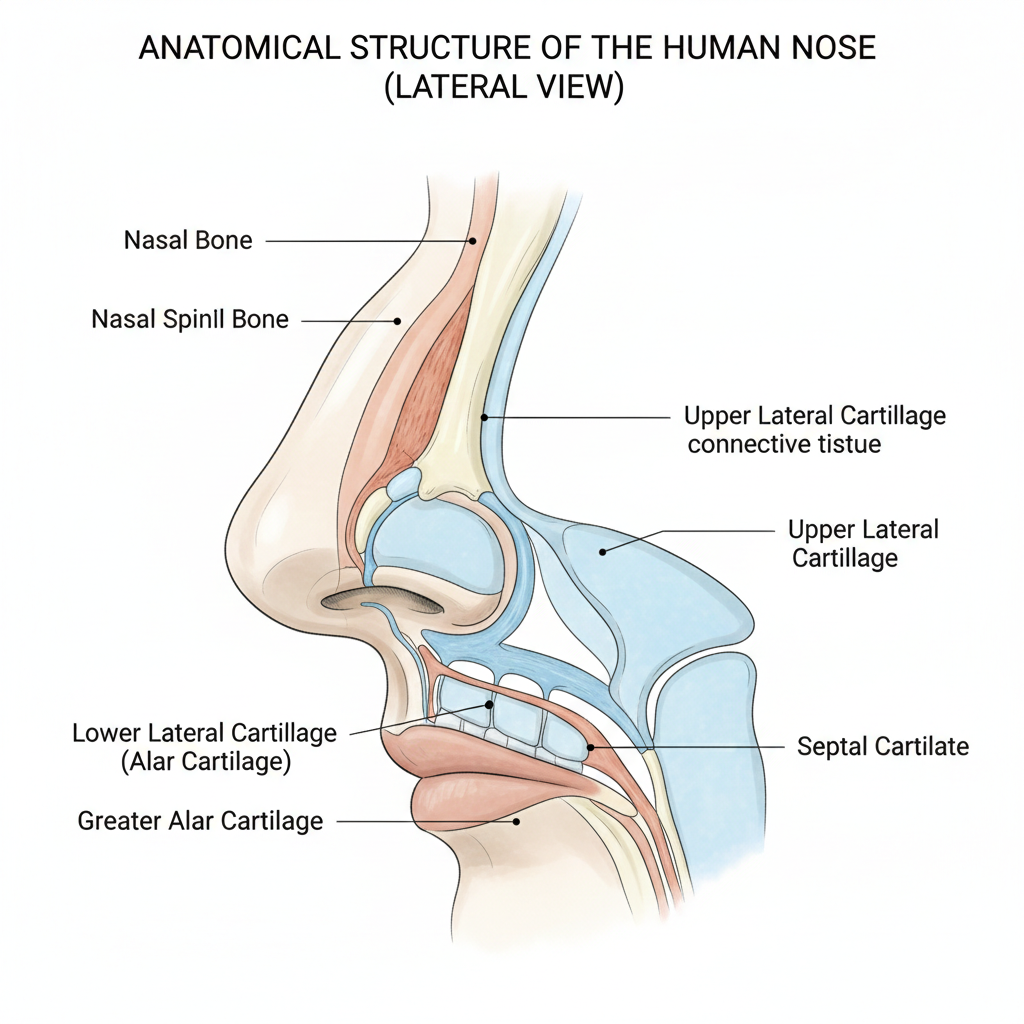
The term ‘rhinoplasty’ comes from the Greek words ‘rhinos’ (nose) and ‘plastikos’ (to shape or mold). This surgery can address both cosmetic concerns such as the size, shape, or symmetry of your nose and functional issues like difficulty breathing due to structural abnormalities.
Key Goals of Rhinoplasty
Rhinoplasty can achieve multiple aesthetic and functional goals:
- Changing the angle between the nose and upper lip
- Refining or reshaping the nasal tip (making it less bulbous, more defined, or elevated)
- Narrowing the nasal bridge or nostril width
- Straightening a crooked nose or correcting asymmetry
- Removing or reducing humps or depressions on the nasal bridge
- Improving breathing function by correcting a deviated septum or other internal issues
- Repairing damage from injury or trauma
Types of Rhinoplasty: Finding Your Procedure
Not all rhinoplasty procedures are the same. Understanding the different types helps you communicate effectively with your surgeon and ensures you receive the right treatment for your specific needs and goals.
1. Cosmetic Rhinoplasty
Cosmetic rhinoplasty focuses purely on improving the aesthetic appearance of your nose. This is what most people think of when they hear ‘nose job.’ The goal is to create a nose that harmonizes with your other facial features while maintaining a natural appearance.
Common cosmetic concerns addressed:
- A nose that appears too large or too small for the face
- A prominent dorsal hump (bump on the bridge)
- A bulbous, drooping, or upturned nasal tip
- Wide or flared nostrils
- Nasal asymmetry or crookedness
💡 Important Note: Cosmetic rhinoplasty is typically not covered by insurance as it’s considered an elective procedure. However, if you combine it with functional improvements, part of the cost may be covered.
2. Functional Rhinoplasty
Functional rhinoplasty addresses medical issues that impair breathing or nasal function. This type of surgery is often covered by insurance when deemed medically necessary, though you’ll need proper documentation from your doctor.
Common functional issues treated:
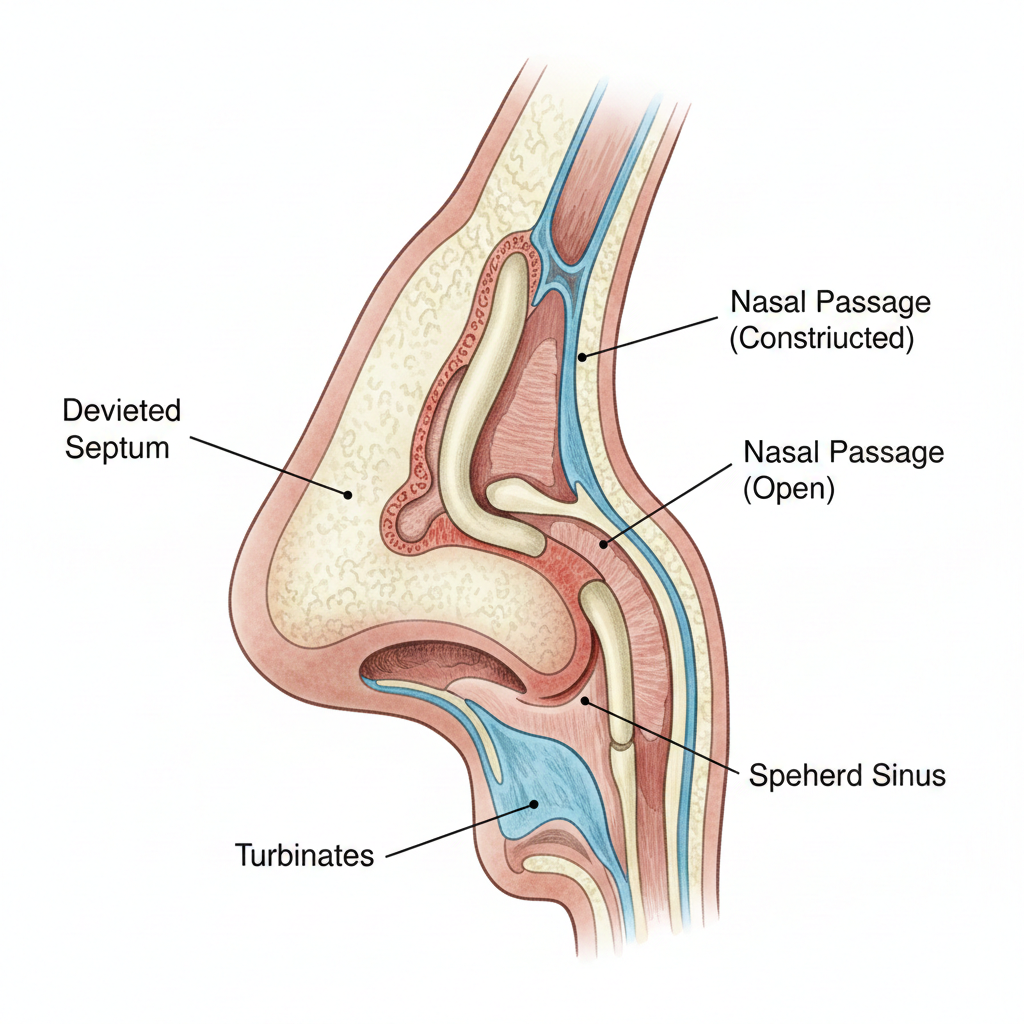
- Deviated septum (the wall between nostrils is off-center)
- Collapsed nasal valves causing breathing difficulty
- Enlarged turbinates (bony structures inside the nose)
- Chronic sinus problems related to structural abnormalities
- Sleep apnea symptoms caused by nasal obstruction
Many patients opt for combined cosmetic and functional rhinoplasty in a single surgery, addressing both breathing and aesthetic concerns simultaneously. This approach is often more cost-effective and requires only one recovery period.
3. Revision (Secondary) Rhinoplasty
Revision rhinoplasty is performed to correct issues from a previous nose surgery. This could be due to unsatisfactory aesthetic results, breathing problems that developed after the first surgery, or complications from the initial procedure.
Why revision rhinoplasty is more complex:
- Scar tissue from the first surgery makes the anatomy more challenging
- Less cartilage may be available for reshaping
- Cartilage grafts (from ear or rib) may be needed
- Recovery time is typically longer
- Costs are usually 30-50% higher than primary rhinoplasty
4. Ethnic Rhinoplasty
Ethnic rhinoplasty is designed to enhance the nose while preserving ethnic identity and cultural features. This specialized approach recognizes that different ethnicities have distinct nasal characteristics and that a ‘one-size-fits-all’ approach doesn’t respect individual heritage.
Considerations by ethnicity:
- African American rhinoplasty: Often focuses on refining the nasal tip while maintaining width, and may involve augmentation of the bridge
- Asian rhinoplasty: Frequently includes bridge augmentation and tip refinement while preserving ethnic characteristics
- Middle Eastern rhinoplasty: Typically addresses prominent dorsal humps and drooping tips while maintaining strong, refined features
- Hispanic rhinoplasty: May involve tip refinement, hump reduction, or narrowing while respecting cultural identity
5. Post-Traumatic Rhinoplasty
This type of rhinoplasty repairs damage from accidents, sports injuries, or physical trauma. Post-traumatic rhinoplasty can address both functional and aesthetic concerns resulting from injury, including:
- Broken nasal bones causing crookedness
- Damaged cartilage affecting nose shape or breathing
- Scar tissue from previous injuries
- Deviated septum caused by trauma
Surgical Approach: Open vs. Closed Rhinoplasty
Regardless of the type of rhinoplasty you’re having, your surgeon will use one of two surgical techniques:
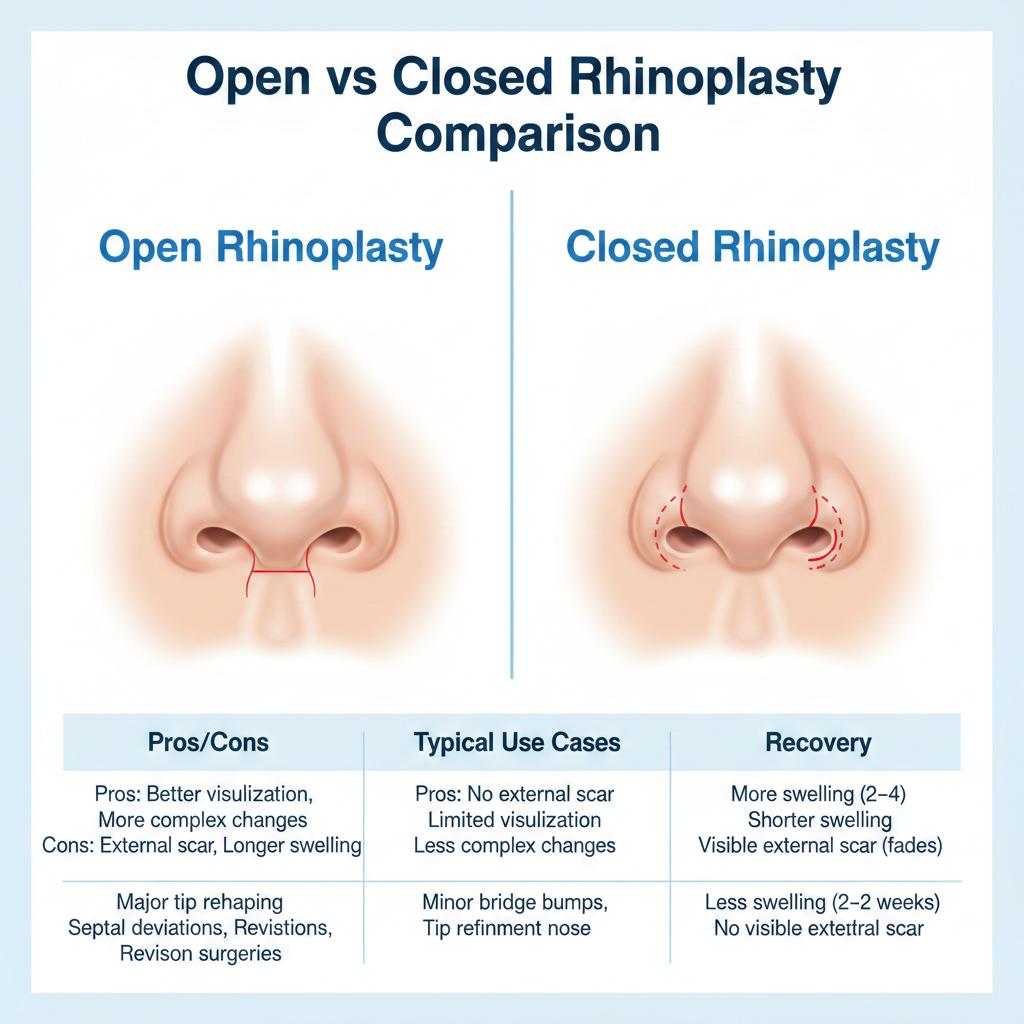
Open Rhinoplasty:
- Small incision made on the columella (the strip of tissue between nostrils)
- Provides maximum visibility and access for complex reshaping
- Preferred for major changes, revision surgery, and complex cases
- Leaves a small scar that typically fades to near-invisibility within months
Closed Rhinoplasty:
- All incisions made inside the nostrils
- No external scarring
- Less swelling and slightly faster recovery
- Better for minor refinements and less complex changes
Who Is a Good Candidate for Rhinoplasty?
Not everyone is an ideal candidate for rhinoplasty. Your surgeon will evaluate multiple factors to determine if you’re ready for this transformative procedure. Understanding these criteria helps you assess your own candidacy and prepare for your consultation.
Physical Candidacy Requirements
Age and Facial Development
Your nose must be fully developed before undergoing rhinoplasty. For girls, facial growth typically completes around age 15-16, while for boys, it’s usually 17-18. However, many surgeons recommend waiting until at least age 18 to ensure emotional maturity and realistic expectations. Functional rhinoplasty for breathing problems may be performed earlier if medically necessary.
Good Overall Health
Ideal candidates should:
- Be in good general health with no serious medical conditions
- Be a non-smoker (or willing to quit for at least 4 weeks before and after surgery)
- Have no active infections or untreated medical issues
- Not have bleeding disorders or take blood-thinning medications (unless approved by your doctor)
- Have realistic expectations about results and recovery
🚨 Medical Conditions That May Affect Candidacy: Uncontrolled diabetes, autoimmune disorders, blood clotting disorders, severe allergies, active infections, or unstable psychiatric conditions may require special consideration or delay surgery.
Psychological and Emotional Readiness
Realistic Expectations
Understanding what rhinoplasty can and cannot achieve is crucial. The best candidates:
- Want to improve their nose for themselves, not to please others
- Understand that rhinoplasty enhances features but doesn’t create perfection
- Accept that final results take 12-18 months to fully develop
- Have specific concerns they can articulate to their surgeon
- Don’t expect rhinoplasty to solve all life problems or dramatically change their life
Red Flags for Poor Candidacy:
- Body dysmorphic disorder (BDD) or obsessive focus on minor flaws
- Expecting to look exactly like a celebrity or photo
- Undergoing surgery to please a partner or parent
- Recently experiencing major life stress or depression
- Having had multiple cosmetic procedures with persistent dissatisfaction
Specific Concerns Rhinoplasty Can Address
You may be a good candidate if you have concerns about:
- Size: Your nose appears too large or too small for your face
- Width: Your nose is too wide at the bridge or nostrils are flared
- Profile: You have a visible hump or depression on the bridge
- Tip shape: Your nasal tip is bulbous, drooping, upturned, or hooked
- Asymmetry: Your nose is crooked or off-center
- Breathing: You have difficulty breathing through your nose
- Previous injury: Trauma has changed your nose shape or function
Self-Assessment Checklist
Before scheduling a consultation, ask yourself:
- Have I thought about this decision for at least 6 months?
- Can I clearly describe what bothers me about my nose?
- Am I emotionally stable and making this decision freely?
- Can I take 1-2 weeks off work/school for recovery?
- Do I have realistic expectations about the results?
- Am I prepared for the financial investment?
- Have I researched qualified surgeons in my area?
If you answered ‘yes’ to most of these questions, you may be ready to schedule a consultation with a board-certified plastic surgeon or facial plastic surgeon who specializes in rhinoplasty.
The Rhinoplasty Procedure
Understanding what actually happens during rhinoplasty surgery helps reduce anxiety and allows you to prepare mentally and physically. While every surgery is customized to the patient’s needs, the general process follows a predictable sequence.
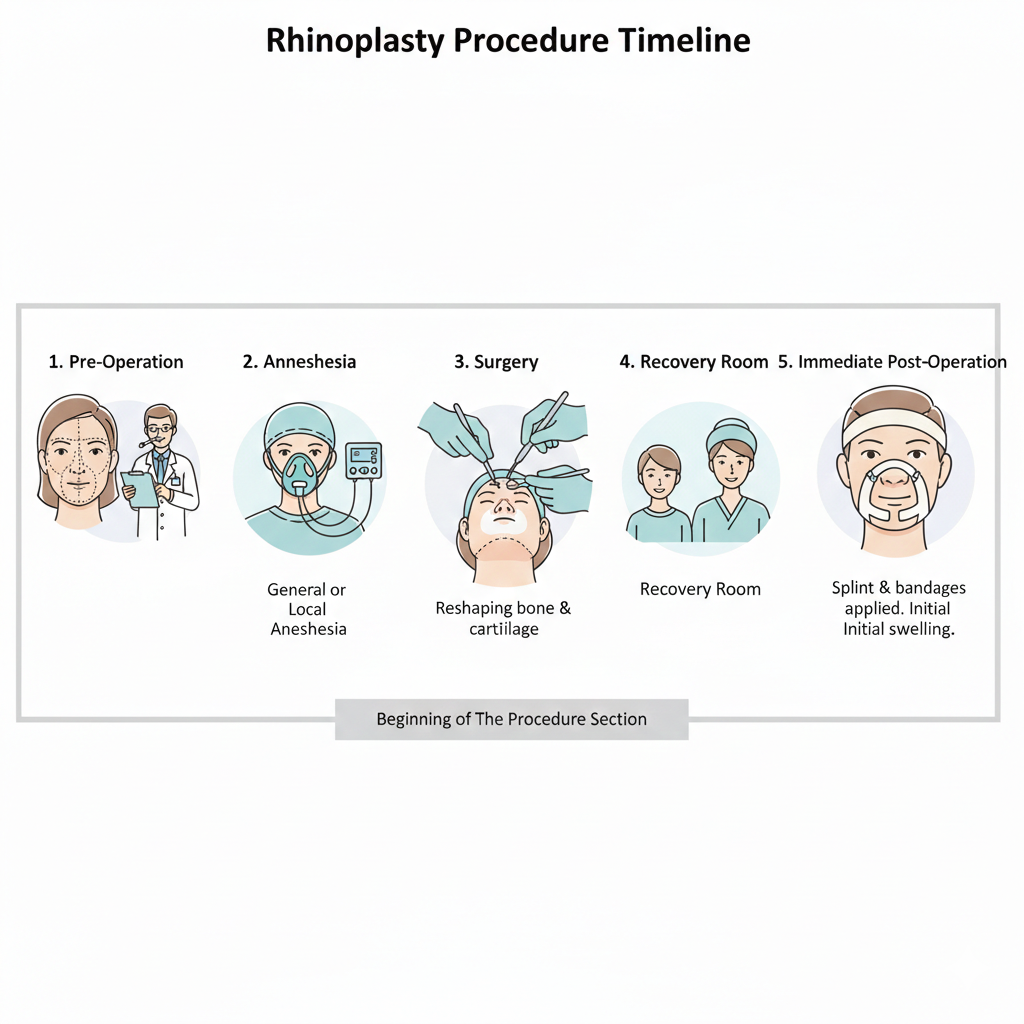
Pre-Operative Preparation (Day of Surgery)
Arrival and Check-In (6:00 AM – 6:30 AM typical)
You’ll arrive at the surgical facility (hospital or accredited outpatient surgery center) typically 1-2 hours before your scheduled surgery time. You should:
- Have fasted (no food or drink) for at least 8 hours
- Wear comfortable, loose clothing that doesn’t pull over your head
- Have removed all jewelry, makeup, nail polish, and contact lenses
- Bring a companion to drive you home
Pre-Op Consultation (6:30 AM – 7:00 AM)
Your surgeon will meet with you one final time to:
- Review the surgical plan and confirm your goals
- Mark your nose with a surgical marker
- Take final pre-operative photos
- Answer any last-minute questions
The Surgical Process (1.5 – 3 hours)
Step 1: Anesthesia (15-20 minutes)
Rhinoplasty is performed under general anesthesia, meaning you’ll be completely asleep and won’t feel anything. An anesthesiologist will:
- Place an IV line for medications and fluids
- Administer anesthesia medications
- Monitor your vital signs throughout the entire procedure
- Ensure you remain comfortable and stable
Step 2: Making the Incisions (5-10 minutes)
Your surgeon will make incisions based on the chosen approach:
- Open rhinoplasty: A small incision across the columella plus internal incisions
- Closed rhinoplasty: All incisions hidden inside the nostrils
The skin is then carefully lifted to expose the underlying bone and cartilage structure, much like opening a hood to access an engine.
Step 3: Reshaping the Nose (60-120 minutes)
This is where the transformation happens. Your surgeon will:
- Remove or add bone/cartilage: Humps are shaved down, weak areas are built up with grafts
- Reshape the tip: Refine, narrow, or rotate the nasal tip by adjusting cartilage
- Narrow the bridge: Perform osteotomies (controlled bone breaks) to narrow a wide nose
- Straighten a crooked nose: Adjust bone and cartilage positioning
- Adjust nostrils: Reduce width through alar base reduction if needed
- Correct breathing issues: Straighten septum, reduce turbinates, reinforce valve areas
Step 4: Closing the Incisions (15-20 minutes)
Once reshaping is complete:
- The skin is carefully redraped over the new structure
- Incisions are closed with dissolvable sutures
- Soft internal splints may be placed inside the nostrils
- A rigid external splint is applied to protect the nose
- Tape and sometimes a drip pad under the nose manages drainage
Immediate Post-Operative Care
Recovery Room (1-2 hours)
After surgery, you’ll be moved to a recovery area where you’ll gradually wake up. You may experience:
- Grogginess and disorientation from anesthesia
- Nausea (common with anesthesia)
- Facial pressure and tightness
- Difficulty breathing through your nose (you’ll breathe through your mouth)
- Minimal to moderate discomfort (pain medications will be provided)
Nurses will monitor your vital signs, provide ice packs to reduce swelling, and ensure you’re stable before discharge. Most patients go home 2-3 hours after surgery.
What You’ll Look Like Immediately After Surgery
Be prepared for significant swelling and bruising:
- Your face will be puffy, especially around the eyes
- Dark bruising (like black eyes) is common but varies by person
- The nasal splint and tape will cover your nose entirely
- You’ll have a drip pad (gauze mustache) to catch drainage
- Your nose will feel completely congested
💡 Pro Tip: Take before photos on the day of surgery so you can track your dramatic improvement during recovery. It helps maintain perspective when you’re feeling discouraged during the swelling phase.
Rhinoplasty Recovery
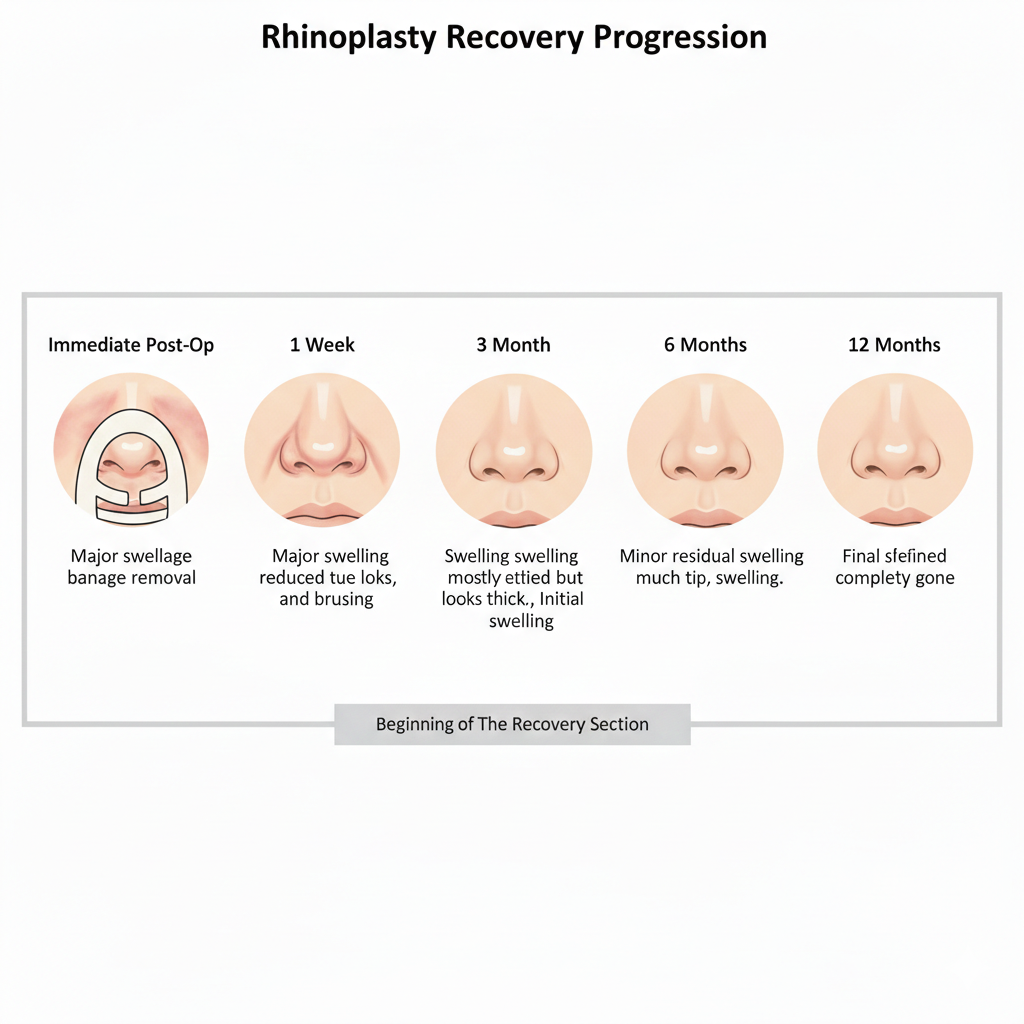
Recovery from rhinoplasty is a gradual process that requires patience. While you’ll see significant improvement within the first few weeks, your final result won’t be fully visible for 12-18 months. Understanding each phase helps you maintain realistic expectations and follow proper aftercare.
First 24 Hours: The Critical Period
What to Expect:
The first day after surgery is the most uncomfortable, but it’s also when your body begins its remarkable healing journey.
Physical Symptoms:
- Significant facial swelling, especially around eyes and nose
- Bruising beginning to appear (peaks at 48-72 hours)
- Nasal congestion requiring mouth breathing
- Mild to moderate pain (manageable with prescribed medication)
- Some bleeding or drainage (this is normal)
- Dry mouth from breathing through your mouth
- Fatigue and grogginess from anesthesia
What You Should Do:
- Rest with your head elevated at 30-45 degrees (use 2-3 pillows)
- Apply ice packs around (not on) your nose for 20 minutes every hour
- Take pain medication as prescribed
- Drink plenty of water
- Eat soft, cool foods (avoid hot foods that increase blood flow to face)
- Avoid bending over, straining, or heavy lifting
- Do NOT blow your nose
- Change drip pad as needed
What You Should NOT Do:
- Lie flat (increases swelling)
- Touch or bump your nose
- Engage in any physical activity
- Smoke or drink alcohol
- Take aspirin or ibuprofen (increases bleeding risk)
- Wear glasses (they’ll rest on your nose)
Days 2-7: The Splint Phase
What to Expect:
Swelling and bruising peak around day 2-3, then gradually improve. You’ll still have your external splint and possibly internal splints, which can feel restrictive but are essential for proper healing.
Physical Changes:
- Days 2-3: Peak swelling and bruising (you may look worse before you look better)
- Days 4-5: Bruising starts changing from dark purple to yellow/green
- Days 6-7: Noticeable reduction in swelling and bruising
Daily Activities:
- Continue sleeping elevated
- Gentle face washing around splint (don’t get splint wet)
- Short walks around the house (promotes circulation)
- Light reading, watching TV, working on laptop
- Most people feel well enough to work from home by day 4-5
Splint Removal (Day 5-7):
This is a major milestone! When your surgeon removes the external splint:
- The process is quick and painless (no stitches to remove with dissolvable sutures)
- Your nose will look swollen and possibly crooked (this is normal)
- You may be surprised by how different it looks (remember: still very swollen)
- Your surgeon may apply new tape to support the nose
- You’ll see your new shape for the first time, but it’s only about 20% of the final result
Weeks 2-4: Returning to Normal
Week 2:
- Most visible bruising has faded (can be covered with makeup)
- Swelling reduced by about 50-60%
- You can return to work/school if job is not physically demanding
- Can resume light exercise (walking, light yoga)
- Can wear glasses with special support or tape
- Still shouldn’t wear sunglasses resting on nose
Week 3:
- Feel mostly “normal” but nose still appears swollen to you (others may not notice)
- Can resume most normal activities
- May experience numbness in tip (this is normal and temporary)
- Can gently blow nose if needed (but avoid forceful blowing)
Week 4:
- About 70% of swelling resolved
- Can return to more vigorous exercise (avoid contact sports)
- Nose may still feel stiff or tight
- Sensation gradually returning
- Can see your new profile emerging
Months 2-6: Gradual Refinement
Month 2:
- About 80% of swelling gone
- Nose starting to look like final result
- Can resume all normal activities including contact sports (with protection)
- Can wear sunglasses normally
- Subtle changes continue happening
Month 3:
- About 85-90% of swelling resolved
- Most people feel they can see their “final” result (but more refinement coming)
- Scar from open rhinoplasty nearly invisible
- Nasal tip still slightly swollen and may feel firm
Months 4-6:
- 90-95% of swelling gone
- Continued subtle refinement
- Tip definition improving
- Breathing usually fully improved if functional work was done
- Can undergo facial treatments (facials, microneedling) with doctor approval
Months 6-12: Final Results Emerging
Month 6:
- Most swelling resolved (95%+)
- Result very close to final outcome
- Tip still refining (especially for thicker skin)
- Scars completely faded
Month 12:
- Final result achieved
- All swelling resolved
- True shape of your nose is now visible
- Tip fully refined and settled
- This is the result you’ll maintain long-term
Month 18 (for some patients):
- Patients with thick skin may continue to see minor refinement up to 18 months
- Final, final result for thick-skinned patients
Recovery Do’s and Don’ts Timeline
| Timeframe | CAN DO | CANNOT DO |
|---|---|---|
| Week 1 | Rest, elevate head, ice, gentle walking | Exercise, blow nose, bend over, lift heavy objects, wear glasses |
| Week 2 | Return to work (desk job), light exercise, makeup | Vigorous exercise, contact sports, swim, sunbathe |
| Week 3-4 | Moderate exercise, blow nose gently, most activities | Contact sports, heavy lifting (>20 lbs), intense cardio |
| Month 2 | Resume all exercise, wear glasses normally | Contact sports without protection |
| Month 3+ | Everything including contact sports | Nothing restricted (fully healed externally) |
Managing Common Recovery Concerns
Swelling That Won’t Go Away:
- Tip swelling is the last to resolve (can take 12-18 months)
- Thick skin takes longer to contract
- Salt intake can increase swelling
- Morning swelling is normal for first few months
- Sleeping elevated helps
Breathing Difficulties:
- Normal for first 1-2 weeks due to internal swelling
- Internal splints (if used) will be removed at 1 week, improving breathing
- May take 3-6 months for full breathing improvement
- Nasal saline spray helps
- Contact surgeon if breathing doesn’t improve by 6 weeks
Numbness:
- Tip numbness is very common (can last 3-12 months)
- Upper lip numbness may occur (usually resolves in weeks)
- Teeth numbness (rare, usually temporary)
- Sensation returns gradually
Asymmetry:
- Swelling is asymmetric, causing temporary unevenness
- True asymmetry can’t be assessed until 12 months
- Most “asymmetry” at 1-3 months is just uneven swelling
Emotional Ups and Downs:
- Common to feel regret or depression in first 2 weeks (called “post-surgical blues”)
- Seeing yourself swollen can be distressing
- Results seem underwhelming at first
- This is NORMAL and passes as healing progresses
- Reach out to surgeon if feelings persist
Rhinoplasty Risks and Complications
Like any surgical procedure, rhinoplasty carries potential risks. Understanding these complications helps you make an informed decision and recognize when to seek medical attention during recovery. The good news: serious complications are rare with an experienced, board-certified surgeon.
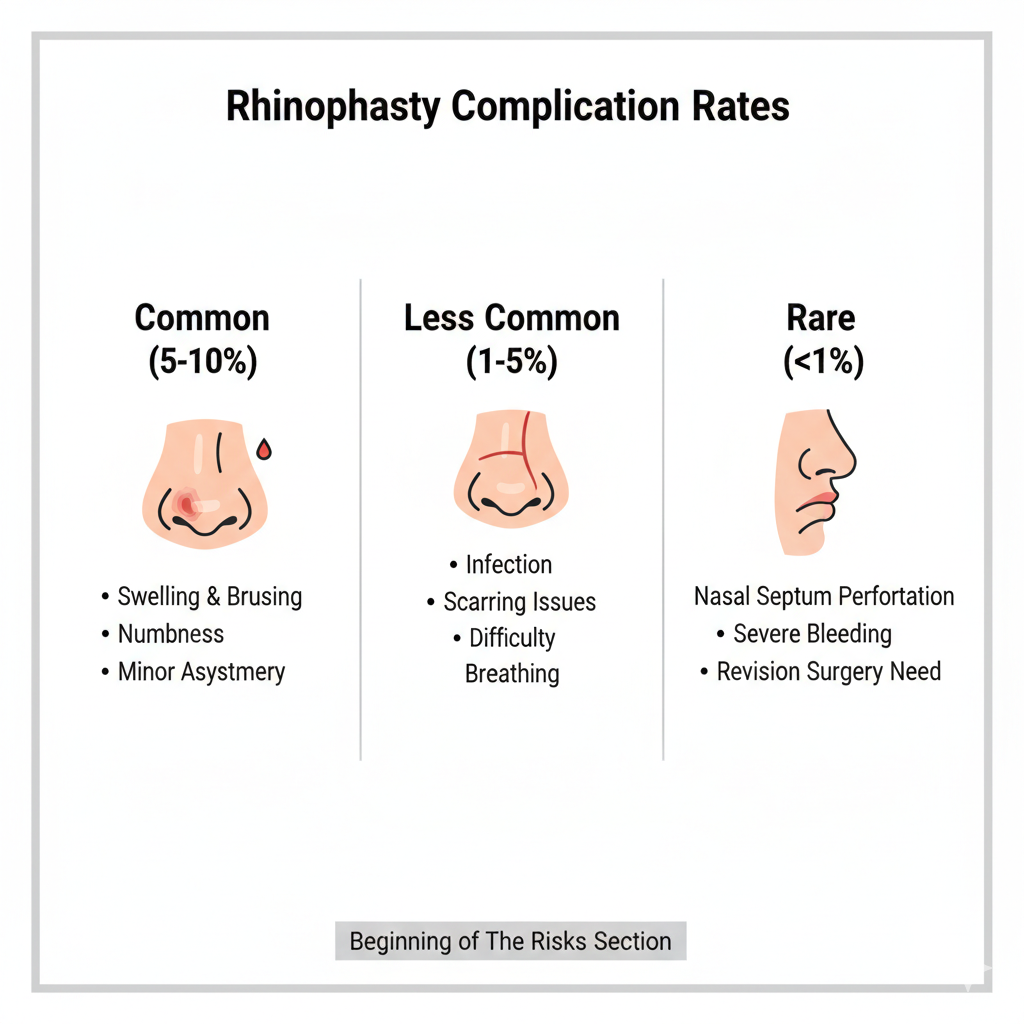
Common Complications (Occur in >5% of patients)
These are generally minor and temporary:
1. Swelling and Bruising
- Expected part of recovery, not truly a “complication”
- Peaks at 2-3 days, mostly resolved by 2-3 weeks
- Management: Ice, elevation, rest, avoid salt
2. Temporary Numbness
- Nasal tip, upper lip, or teeth may feel numb
- Usually resolves within 3-12 months
- Caused by swelling pressure on nerves
- No treatment needed; sensation returns naturally
3. Nasal Congestion
- Internal swelling blocks airways temporarily
- Lasts 1-4 weeks typically
- Management: Saline spray, humidifier, elevation
- Improves as swelling subsides
4. Minor Bleeding
- Light oozing for first 24-48 hours is normal
- Drip pad catches drainage
- Contact surgeon if bleeding is heavy or doesn’t stop
Uncommon Complications (Occur in 1-5% of patients)
1. Infection
- Risk: ~2-3% of patients
- Signs: Increasing redness, warmth, pus, fever, worsening pain after day 3
- Prevention: Antibiotics (often prescribed preventatively), proper wound care
- Treatment: Antibiotics, rarely requires drainage
- When to call: If you develop fever >101°F or see pus
2. Prolonged Swelling
- Some patients (especially thick skin) have swelling lasting >12 months
- Not dangerous, just cosmetically frustrating
- More common in revision rhinoplasty
- Eventually resolves but requires patience
3. Minor Asymmetry
- Slight unevenness that may require revision
- Can’t be fully assessed until 12 months post-op
- May be due to healing, scar tissue, or surgical factors
- Often less noticeable to others than to patient
4. Skin Problems
- Tiny broken blood vessels (telangiectasias) on nose
- Skin redness or changes in skin texture
- Usually temporary, may take months to resolve
- Laser treatment can address persistent vessels
5. Persistent Nasal Obstruction
- Breathing doesn’t improve as expected (if functional work done)
- May be due to scar tissue, valve collapse, or residual deviation
- Evaluation after 6 months when swelling resolves
- May require revision surgery
Rare but Serious Complications (Occur in <1% of patients)
1. Septal Perforation
- Hole in the nasal septum
- Risk: <1% with experienced surgeons
- Symptoms: Whistling sound, crusting, bleeding
- Treatment: May require surgical repair
2. Skin Necrosis
- Rare loss of skin blood supply causing tissue death
- More common in smokers
- Requires immediate treatment
- Prevention: DON’T SMOKE before/after surgery
3. Severe Breathing Problems
- Nasal valve collapse causing significant obstruction
- May require revision surgery to correct
- More common in aggressive reduction rhinoplasty
4. Anesthesia Complications
- Allergic reaction to anesthesia (extremely rare)
- Nausea and vomiting (common, not serious)
- Serious reactions (<1 in 10,000 with healthy patients)
5. Unsatisfactory Aesthetic Result Requiring Revision
- Risk: 5-15% of patients seek revision (industry-wide)
- Reasons: Patient expectations not met, healing didn’t go as planned, surgical technique
- Revision can address most concerns
- Must wait 12+ months before revision
Extremely Rare Life-Threatening Complications (<0.1%)
Death from rhinoplasty is exceptionally rare (estimated 1 in 50,000 to 1 in 100,000 procedures). Possible causes include:
- Severe allergic reaction to anesthesia
- Blood clot (pulmonary embolism)
- Heart attack or stroke during surgery
- Severe bleeding
These risks are minimized by:
- Choosing board-certified surgeon
- Having surgery in accredited facility
- Full medical evaluation before surgery
- Experienced anesthesiologist
- Proper patient screening
How to Minimize Your Risk
Choose the Right Surgeon:
- Board-certified in plastic surgery or facial plastic surgery
- Extensive rhinoplasty experience (ask how many per year)
- Hospital privileges (even if surgery at outpatient center)
- Good track record with low complication rates
- Open about risks and realistic about results
Be Honest About Your Health:
- Disclose all medications, supplements, herbs
- Report any medical conditions
- Mention previous surgeries or complications
- Don’t hide smoking or drug use
- Discuss mental health concerns
Follow Pre-Op Instructions:
- Stop smoking 4+ weeks before surgery
- Avoid aspirin, ibuprofen, vitamin E, fish oil for 2 weeks before
- Don’t eat or drink after midnight before surgery
- Arrange for responsible adult to drive and stay with you
- Fill prescriptions before surgery
Follow Post-Op Instructions Meticulously:
- Take medications as prescribed
- Keep head elevated
- Avoid activities that increase blood pressure
- Don’t touch or bump your nose
- Attend all follow-up appointments
- Report any concerning symptoms immediately
Warning Signs to Contact Your Surgeon Immediately
Call your surgeon right away if you experience:
- Fever above 101°F (38.3°C)
- Heavy bleeding that doesn’t stop with pressure
- Severe pain not controlled by medication
- Signs of infection: increasing redness, warmth, pus, foul odor
- Difficulty breathing or chest pain (call 911)
- One-sided swelling or severe asymmetric swelling
- Vision changes or severe headache
- Pus or green/yellow discharge from incisions
- Unusual swelling, redness, or pain in legs (possible blood clot)
Most rhinoplasty patients experience a smooth recovery with no complications. Being informed about risks doesn’t mean they’ll happen to you it means you’re prepared to recognize and address issues if they arise.
Rhinoplasty Cost
Understanding the full financial commitment of rhinoplasty helps you plan and budget appropriately. Costs vary widely based on surgeon experience, geographic location, and procedure complexity.
National Average Costs (2025)
Total Rhinoplasty Cost Range: $5,500 – $15,000+
Average Cost: $8,000 – $10,000 for primary cosmetic rhinoplasty
This is a wide range because costs vary significantly based on:
- Surgeon’s experience and reputation
- Geographic location (major cities cost more)
- Complexity of procedure
- Type of rhinoplasty (primary vs. revision)
- Facility fees
- Anesthesia type
Cost Breakdown: What’s Included
| Component | Average Cost | Notes |
|---|---|---|
| Surgeon’s Fee | $4,000 – $8,000 | Covers surgical expertise, consultation, follow-ups |
| Anesthesia Fee | $800 – $1,500 | General anesthesia by anesthesiologist |
| Facility Fee | $1,000 – $3,000 | Operating room, equipment, nursing staff |
| Medical Tests | $100 – $300 | Pre-op bloodwork, EKG if needed |
| Prescriptions | $50 – $150 | Pain medication, antibiotics, anti-nausea |
| Post-Surgery Supplies | $50 – $200 | Ice packs, saline spray, ointments |
| Follow-Up Visits | Usually included | Typically included in surgeon’s fee |
| TOTAL | $5,500 – $15,000 | Higher in major metropolitan areas |
Cost Variations by Type
Primary Cosmetic Rhinoplasty: $5,500 – $12,000
- Most common type
- Varies by complexity
Functional Rhinoplasty (Septoplasty): $3,000 – $8,000
- May be partially covered by insurance
- Lower cost if purely functional
Combined Functional + Cosmetic: $8,000 – $15,000
- Insurance may cover functional portion
- Patient pays cosmetic portion out-of-pocket
Revision Rhinoplasty: $10,000 – $20,000+
- 30-50% more expensive than primary
- More complex, requires specialized expertise
- Often needs cartilage grafts (adds cost)
Ethnic Rhinoplasty: $7,000 – $15,000
- Similar to primary rhinoplasty range
- May require special techniques or grafts
Geographic Cost Variations
Major Metropolitan Areas (Higher Costs):
- New York City: $10,000 – $20,000+
- Los Angeles: $9,000 – $18,000+
- San Francisco: $9,000 – $17,000+
- Miami: $8,000 – $15,000+
- Boston: $8,000 – $15,000+
Mid-Size Cities (Moderate Costs):
- Denver: $7,000 – $12,000
- Dallas: $6,500 – $11,000
- Chicago: $7,500 – $13,000
- Atlanta: $6,500 – $11,000
Smaller Cities/Rural Areas (Lower Costs):
- $5,500 – $9,000 typical range
- Lower overhead means lower fees
- May have fewer highly specialized surgeons
Insurance Coverage
What Insurance MAY Cover:
- Functional rhinoplasty to correct breathing problems
- Septoplasty for deviated septum
- Turbinate reduction for obstruction
- Repair of traumatic injury (recent or past)
What Insurance WON’T Cover:
- Cosmetic changes to appearance
- Refinement of tip for aesthetics
- Narrowing bridge for looks
- Nostril reduction
Getting Insurance Coverage:
- Document breathing problems with your doctor
- Try conservative treatments first (medications, sprays)
- Get sleep study if sleep apnea suspected
- Obtain pre-authorization from insurance
- Expect to pay cosmetic portion out-of-pocket if combining
Typical Insurance Coverage: 30-60% of total cost if functional component is approved
Financing Options
1. Medical Credit Cards:
- CareCredit, Prosper Healthcare Lending
- Often offer 0% APR for 12-24 months if paid in full
- After promotional period: 15-30% APR
- Apply before surgery
2. Personal Loans:
- Bank or credit union personal loans
- Interest rates: 6-15% typically
- Fixed monthly payments
- Check your credit score first
3. Payment Plans Through Surgeon:
- Some practices offer in-house financing
- May require down payment (30-50%)
- Monthly payments over 6-12 months
- Ask about interest/fees
4. Health Savings Account (HSA) or Flexible Spending Account (FSA):
- Can use for functional portion
- Pre-tax dollars
- Check with your plan administrator
5. Save and Pay Cash:
- No interest or fees
- Some surgeons offer cash discounts (5-10%)
- Gives you time to research thoroughly
Hidden Costs to Consider
Potential Additional Expenses:
- Time off work (1-2 weeks, possibly unpaid)
- Travel costs if seeing out-of-town surgeon
- Accommodation if traveling
- Revision surgery if needed (hopefully not, but possible)
- Special pillows, recovery supplies
- Help at home (hiring caregiver if needed)
- Scar treatments (rare, but silicone sheets if needed)
Budget Extra: 10-15% above quoted price for unexpected costs
Why You Shouldn’t Choose Based on Price Alone
Cheapest Option Can Be Most Expensive:
- Inexperienced surgeons may have higher revision rates
- Poor results require costly revision surgery
- Complications can require additional procedures
- Emotional toll of poor results is immeasurable
What You’re Paying For:
- Surgeon’s skill, experience, and artistry
- Safety of accredited facility
- Quality anesthesia care
- Proper follow-up care
- Peace of mind
Red Flags:
- Price significantly below average (>30% lower)
- Pressure to book immediately with “discount”
- No board certification
- Surgery performed in non-accredited facility
- “Bargain” revision rhinoplasty offers
Questions to Ask About Cost
During Consultation:
- “What is the total cost, including all fees?”
- “What does your fee include?” (follow-ups, revisions if needed?)
- “Are there any additional costs I should expect?”
- “Do you offer financing options?”
- “What is your revision policy if results aren’t as expected?”
- “Is a deposit required? Is it refundable?”
- “What forms of payment do you accept?”
Is Rhinoplasty Worth the Cost?
For most patients who’ve thoroughly researched and chosen a skilled surgeon: Yes.
What patients say:
- 90%+ satisfaction rate with rhinoplasty
- “I wish I’d done it sooner”
- “Best money I’ve ever spent”
- Improved confidence and quality of life
- Relief from breathing problems
Consider:
- This is a permanent change to your face
- You’ll see the results every day for the rest of your life
- Investing in an experienced surgeon pays off
- Functional improvements (breathing) have health benefits
- Emotional and psychological benefits are invaluable
General FAQs
Does rhinoplasty hurt?
Most patients report that rhinoplasty is less painful than expected. During surgery, you’re under general anesthesia and feel nothing. After surgery, you’ll experience pressure and discomfort rather than sharp pain. Most describe it as similar to a sinus infection achy, stuffy, and pressured. Pain peaks on days 2-3 and is manageable with prescribed medication. By day 5-7, most patients only need over-the-counter pain relief or no medication at all.
How long do rhinoplasty results last?
Rhinoplasty results are permanent. Once healed, the structural changes to your nose remain for life. However, your nose will continue to age naturally like the rest of your face. Skin may become thinner, and subtle changes occur over decades, but your nose won’t return to its pre-surgery shape. The cartilage and bone modifications are permanent.
Can I see what I’ll look like before surgery?
Yes! Most surgeons use digital imaging software during consultation to show you potential results. They’ll take photos of your face and digitally modify them to demonstrate possible outcomes. Remember: these are simulations, not guarantees. Your actual results depend on your anatomy, skin quality, healing, and surgical technique. Use imaging as a communication tool to ensure you and your surgeon have aligned expectations.
When can I wear glasses again?
Avoid wearing glasses that rest on your nose for 4 to 6 weeks after surgery, as the weight can distort your healing nose. During this time, tape glasses to your forehead, use special nose-free supports, wear contact lenses, or use very lightweight glasses with tape. After 6 weeks, you can usually resume wearing glasses normally.
When can I exercise after rhinoplasty?
Week 1: walking only. Week 2: light cardio. Week 3: moderate exercise like jogging and yoga. Week 4: most exercise except contact sports. After 6+ weeks: all exercise including contact sports with protection. Always get surgeon clearance before resuming exercise and avoid anything that could risk nose trauma for at least 3 months.
Will I have visible scars?
Closed rhinoplasty leaves no external scars since all incisions are inside the nostrils. Open rhinoplasty creates a small scar on the columella between nostrils that fades to nearly invisible within 6 to 12 months. Alar base reduction leaves tiny scars in the crease where nostril meets cheek, which also fade and remain hidden. Modern techniques make rhinoplasty scarring minimal and well-concealed.
Can rhinoplasty fix breathing problems?
Yes! Functional rhinoplasty addresses breathing issues by straightening a deviated septum, reinforcing collapsed nasal valves, reducing enlarged turbinates, and widening narrow airways. Many patients combine functional and cosmetic rhinoplasty in one surgery. Ensure your surgeon has experience in functional nasal surgery, not just cosmetic reshaping.
What’s the difference between primary and revision rhinoplasty?
Primary rhinoplasty is your first nose surgery. Revision rhinoplasty corrects or improves results from a previous procedure. Revision is more complex due to scar tissue, limited cartilage availability, often requiring grafts from ear or rib, and costs 30 to 50% more. About 10 to 15% of patients eventually seek revision for refinements or corrections.
How do I choose the right rhinoplasty surgeon?
Look for board certification by the American Board of Plastic Surgery or Facial Plastic Surgery, extensive rhinoplasty experience (50+ procedures annually), hospital privileges, relevant before/after photos, and good communication. Red flags include no board certification, limited experience, no relevant photos, perfection guarantees, high-pressure tactics, and suspiciously low prices. Trust your instincts.
What is the success rate of rhinoplasty?
Rhinoplasty has high success rates: 85 to 90% patient satisfaction, 10 to 15% revision rate (often for minor tweaks, not problems), less than 5% significant complications, and over 90% breathing improvement with functional work. Success depends on surgeon skill, realistic expectations, proper candidate selection, following post-op instructions, and individual healing.
Can I get rhinoplasty more than once?
Yes, though each surgery becomes more challenging. First revisions are common and usually successful. Second revisions are more difficult. Third and subsequent revisions are rarely recommended with diminishing returns. Surgeons recommend waiting at least 12 months between procedures. Some nasal areas can only be operated on 2 to 3 times before options become very limited.
What’s the best age to get rhinoplasty?
Minimum age: 15 to 16 for girls, 17 to 18 for boys when facial growth is complete. Functional rhinoplasty can be performed younger if medically necessary. Ideal age is late teens to early 30s due to good skin elasticity and faster healing. No upper age limit if healthy. Patients in their 60s and 70s successfully undergo rhinoplasty. Psychological readiness and realistic expectations matter more than age.
Will insurance cover my rhinoplasty?
Insurance may cover the functional portion if medically necessary: septoplasty for deviated septum, traumatic injury correction, congenital defect repair, and chronic sinus issues. Insurance won’t cover cosmetic changes, previous surgery revisions, tip refinement, or aesthetic reduction/augmentation. You’ll need documented breathing problems, conservative treatment attempts, referrals, pre-authorization, and possibly diagnostic tests. Expect to pay out-of-pocket for cosmetic components.
How long does rhinoplasty surgery take?
Average surgery time is 1.5 to 3 hours depending on complexity. Simple tip refinement takes about 1.5 hours while extensive reconstruction takes 3+ hours. Closed rhinoplasty is slightly faster than open. Revision surgery takes 30 to 60 minutes longer. Adding functional components increases time. Total facility time is 4 to 6 hours including prep and recovery. Longer surgery doesn’t mean better results.
Can I fix my nose without surgery?
Non-surgical “liquid rhinoplasty” using dermal fillers can smooth minor bumps, improve symmetry, slightly lift a drooping tip, and augment a low bridge. Limitations: only adds volume (can’t reduce size), temporary results (6 to 18 months), can’t narrow nose, can’t significantly refine tip, can’t fix breathing, and doesn’t correct major issues. Best for minor tweaks, not a replacement for surgical rhinoplasty.
What is ethnic rhinoplasty, and do I need a specialist?
Ethnic rhinoplasty preserves your ethnic identity while achieving aesthetic goals. Different ethnicities have distinct nasal characteristics requiring specialized techniques. African American noses often need bridge augmentation; Asian noses typically need less reduction; Middle Eastern noses may need hump reduction; Hispanic patients often have thicker skin requiring different approaches. Choose a surgeon with extensive experience with your specific ethnicity and review their relevant before/after photos.
How long until I see my final rhinoplasty results?
Timeline: 1 week (splint off, 80% swollen), 1 month (60 to 70% swelling gone), 3 months (80 to 90% resolved), 6 months (90 to 95% resolved), 12 months (final result for most), 18 months (final for thick-skinned patients). The nasal tip takes longest to refine, especially with thick skin. Be patient. Your nose continues improving for many months after surgery.
What can’t rhinoplasty fix?
Rhinoplasty can’t make you look like a different person, recreate a celebrity’s nose exactly, fix all asymmetries, guarantee happiness from every angle, solve personal problems, change your ethnicity, fix body dysmorphic disorder, or guarantee perfect breathing. It enhances and refines your natural features but doesn’t create perfection. Realistic expectations are essential.
What’s recovery really like? Be honest.
Week 1: Rough with significant swelling, bruising, stuffiness, discomfort. Week 2: Better with splint off, can go out with makeup. Weeks 3 to 4: Mostly normal, still puffy. Months 2 to 3: Feel good, impatient for final results. Months 6 to 12: Happy with results. Emotional ups and downs are normal. Almost everyone says it’s worth it once healed, but it requires patience, commitment, and realistic expectations.