
TL;DR
Rib cartilage rhinoplasty is used when a patient’s own nasal cartilage cannot provide enough structural support, which happens most often in revision cases. This guide covers when rib grafts are necessary, how they compare to septal cartilage, how harvesting works, and what recovery looks like.
There is a version of rhinoplasty most patients never think about until they need it: the version where the nose itself has run out of material to work with.
This happens more often than people expect, especially in patients who have already had one or two prior surgeries. When the septum has been used up and the ears cannot provide enough support, surgeons turn to a source most patients never saw coming.
Rib cartilage rhinoplasty sounds intimidating on the surface. In practice, it is one of the most dependable tools available for rebuilding a nose that needs real structural support.
What Is Rib Cartilage in Rhinoplasty
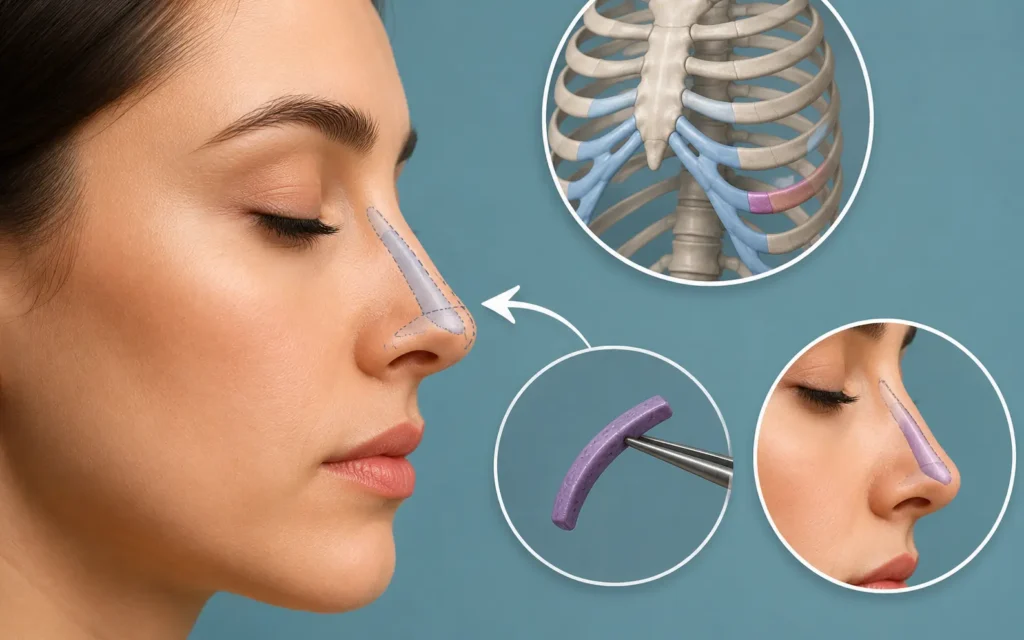
Costal cartilage rhinoplasty uses a small section of cartilage from the ribcage, reshaped into grafts that rebuild structural support inside the nose.
It is not used casually. Surgeons reach for rib graft nose surgery specifically when other, less invasive cartilage sources have already been exhausted or were never sufficient to begin with.
When Is It Necessary
The clearest signal that rib cartilage revision rhinoplasty is needed is a nose that has already been operated on more than once.
Revision rhinoplasty carries a meaningfully higher demand for grafting material than a first time surgery. Published research on rhinoplasty revision rates places surgical revision rates broadly between five and fifteen percent, and secondary cases are far more likely to require structural grafting because prior surgery has already used up the septum or ears.
- Multiple prior rhinoplasty surgeries with limited remaining septal cartilage
- A collapsed or over resected nasal structure needing significant rebuilding
- Congenital or traumatic cases where the nose lacks adequate native cartilage
- Cases where ear cartilage alone will not provide sufficient strength or shape
How It Is Harvested
Cartilage harvest rhinoplasty from the rib involves a small, carefully placed incision along the chest, usually well hidden within the natural chest contour.
A structural rhinoplasty rib graft procedure typically harvests only the amount of cartilage needed for the specific reconstruction, and the donor site is closed with attention to minimizing any visible scarring.
Rib vs Septal Cartilage
Septal cartilage is a surgeon’s first choice whenever it is available, simply because it is already located exactly where it is needed and requires no second incision.
Rib cartilage becomes the better option specifically when septal cartilage is insufficient, previously used, or structurally compromised from an earlier surgery. It offers a larger volume of graft material and, in most cases, more rigidity, which matters for rebuilding significant structural support.
- Septal cartilage: limited supply, ideal location, first choice when available
- Ear cartilage: flexible, useful for smaller grafts, limited structural strength
- Rib cartilage: largest available supply, strongest structural support, requires a separate incision
Recovery With Rib Cartilage
Rib graft recovery involves two healing sites instead of one, the nose and the chest, which does mean a somewhat longer initial recovery window compared to a rhinoplasty using only septal or ear cartilage.
Most patients describe the chest site as manageable discomfort rather than significant pain, particularly with proper post operative guidance, and normal daily activity typically resumes within a couple of weeks.
Long Term Results
The appeal of rib cartilage rhinoplasty is durability. Rib grafts are strong enough to hold their shape reliably over the long term, which is exactly what a rebuilt nasal structure needs after previous surgeries have compromised its natural support.
Conclusion
Needing rib cartilage rhinoplasty is not a sign that something went catastrophically wrong. It is simply a sign that your nose needs more structural material than it currently has, most often because of one or two previous surgeries. This is exactly the kind of case where surgeon experience stops being a preference and becomes a requirement.
Harvesting, carving, and placing rib cartilage correctly takes real technical skill, and a surgeon who does not perform this regularly may hesitate to recommend it even when it is genuinely the right solution. Dr. Ziad Katrib approaches complex and revision rhinoplasty cases with structural rebuilding as a primary tool, not a last resort avoided until every other option fails.
If you have already been through one disappointing surgery, the idea of a second one is understandably exhausting. But a properly planned rib cartilage rhinoplasty is often the difference between a nose that finally holds its shape and one that keeps drifting back toward the same problems. The right graft, placed correctly, can be the last surgery you ever need.
The consultation is $300, available virtually or in person. Call 502-445-9311 or visit ZKNoses.com to book yours.
Frequently Asked Questions
Does rib cartilage rhinoplasty leave a visible scar on the chest?
The incision is small and typically placed along a natural crease or fold, so it heals to be minimally noticeable for most patients.
Is rib cartilage rhinoplasty only for revision cases?
Most commonly yes, though some primary cases with limited natural cartilage supply or complex structural needs may also call for it
Will the rib cartilage warp or change shape over time?
Modern harvesting and carving techniques significantly reduce warping risk, and an experienced surgeon selects and shapes the graft specifically to minimize this.
How long is recovery compared to a standard rhinoplasty?
Expect a slightly longer initial recovery due to the chest incision, though most patients are back to normal activities within two to three weeks.