
TL;DR
For patients across Indiana, Kentucky, and Ohio who have already searched locally and come up short, this guide explains exactly how Dr. Ziad Katrib works as a rhinoplasty specialist serving Indianapolis, Lexington and Cincinnati. It covers why patients from these three cities choose to travel to Louisville, what the process looks like for each city specifically, how revision cases are handled regionally, how out of town consultations actually work from home, and how to book your first appointment without needing to set foot in Kentucky until surgery day.
Why Patients Travel to Louisville for Rhinoplasty

Every week, patients from Indianapolis, Lexington, and Cincinnati look into local options for rhinoplasty and come away with the same conclusion: their city has cosmetic surgery providers, but not a dedicated rhinoplasty specialist with the case volume and focus this procedure demands.
This is not a regional quirk. It reflects a well documented national pattern. Research published by the American Journal of Managed Care on domestic medical travel, defined in the study as elective care sought more than 250 miles from home, found that patients who traveled to high volume, specialized surgeons had shorter hospital stays and fewer complications than patients who stayed local with lower volume providers.
For a procedure as technically demanding as rhinoplasty, that data point matters enormously. According to the American Academy of Facial Plastic and Reconstructive Surgery’s 2024 member survey, 30% of surveyed surgeons said finding the right surgeon is one of the top concerns their patients raise, and that concern is exactly what drives Indianapolis, Lexington, and Cincinnati patients to look beyond their own city limits.
This is why Dr. Katrib’s Louisville practice operates as a genuine rhinoplasty specialist serving Indianapolis, Lexington and Cincinnati rather than treating regional patients as an afterthought. The entire intake process, from virtual consultation through remote follow up, is built specifically around patients who are not local.
It helps to understand why this pattern keeps showing up across the country, not just in this region. Rhinoplasty rewards specialization more than almost any other cosmetic procedure, because a single millimeter of misjudged cartilage work can be the difference between a natural profile and a nose that needs a second surgery. According to the ISAPS Global Survey 2024, rhinoplasty remained among the top five surgical cosmetic procedures performed worldwide, with roughly one million procedures completed globally in a single year, and the American Academy of Facial Plastic and Reconstructive Surgery’s own 2024 data confirms it has stayed among the top three most requested facial procedures for five consecutive years running nationally.
That volume of demand, paired with how technically unforgiving the procedure is, explains why patients from three separate metro areas are willing to cross state lines for the same surgeon rather than split their trust across three separate local providers.
There is also a quieter, more practical reason regional patients travel: pricing transparency and scheduling flexibility tend to be easier to navigate when a practice is specifically built around out of town patients, rather than treating remote scheduling as an inconvenient exception to its normal local workflow.
- Specialization matters more in rhinoplasty than in almost any other cosmetic procedure, given how unforgiving small structural errors can be
- National demand for rhinoplasty has remained in the top three most requested facial procedures for five consecutive years
- A dedicated regional intake process means Indianapolis, Lexington, and Cincinnati patients are never treated as an inconvenient exception
- Transparent virtual scheduling removes the guesswork that often discourages patients from looking outside their home city in the first place
Indianapolis Rhinoplasty Patients

Indianapolis sits close enough to Louisville that the drive is genuinely manageable, generally under three hours depending on traffic through the corridor, which makes it one of the more straightforward regional trips for rhinoplasty.
Patients researching the Indianapolis rhinoplasty patient experience typically start with a virtual consultation from home, then plan a short trip south for the pre operative visit and surgery itself, followed by several days of local recovery before the drive back to Indiana.
This mirrors the broader idea behind traveling for rhinoplasty in general: the trip itself is rarely the hard part. Planning ahead for accommodations, a companion during the first day after surgery, and a realistic recovery window before driving home is what actually determines how smooth the experience feels.
Indianapolis patients considering the trip most often ask about timing around work, since a three hour drive on each side of surgery day adds up when combined with the recovery window itself. In practice, most Indianapolis patients plan for roughly a week away from their normal routine between travel, surgery, and initial healing, though this varies based on individual jobs and how visible early swelling feels to each patient personally.
A local Indianapolis physician can also stay looped into general health questions during recovery if a patient prefers that continuity, while the surgical and rhinoplasty specific follow up remains directly with Dr. Katrib’s team.
- Plan for roughly a week away from normal routine, covering travel, surgery day, and initial local recovery
- Book accommodations within a short drive of the surgical facility rather than across town
- Arrange a companion for at least the first 24 to 48 hours after surgery
- Keep your local Indianapolis physician in the loop for any general health questions during recovery
Lexington Rhinoplasty Patients
Lexington is the closest of the three regional cities to Louisville, roughly eighty miles and about ninety minutes by car, which is short enough that many patients following the rhinoplasty Lexington patient guide plan for only a brief local stay around surgery day.
Because the distance is so manageable, Lexington patients also have an easier time scheduling an occasional in person follow up later in their recovery if their specific case calls for one, something that is more difficult for patients traveling from farther away.
Many Lexington patients treat the trip almost like a day surgery with an overnight buffer built in, arriving the afternoon before their procedure and returning home within two to four days once the surgical team confirms early healing is on track. This shorter window is one of the clearest practical advantages of being the closest of the three regional cities to Louisville.
Cincinnati Rhinoplasty Patients
Cincinnati patients cross the Ohio Kentucky state line for roughly the same reason Indianapolis and Lexington patients do: access to a rhinoplasty specialist rather than a general cosmetic surgery provider. The drive down I 71 runs about ninety minutes under normal conditions.
The rhinoplasty Cincinnati patient process follows the same core structure as the other two regional cities, a virtual consultation first, a focused trip for the pre operative visit and surgery, and remote follow up handled through video calls and photo check ins once patients are back home in Ohio.
Because Cincinnati sits just across the state line from Kentucky, some patients are surprised by how little the crossing itself adds to the process. There is no additional paperwork or licensing hurdle for an Ohio resident choosing a Kentucky based specialist, and the practical experience is essentially identical to a patient driving the same distance within a single state.
Revision Rhinoplasty Regional Hub
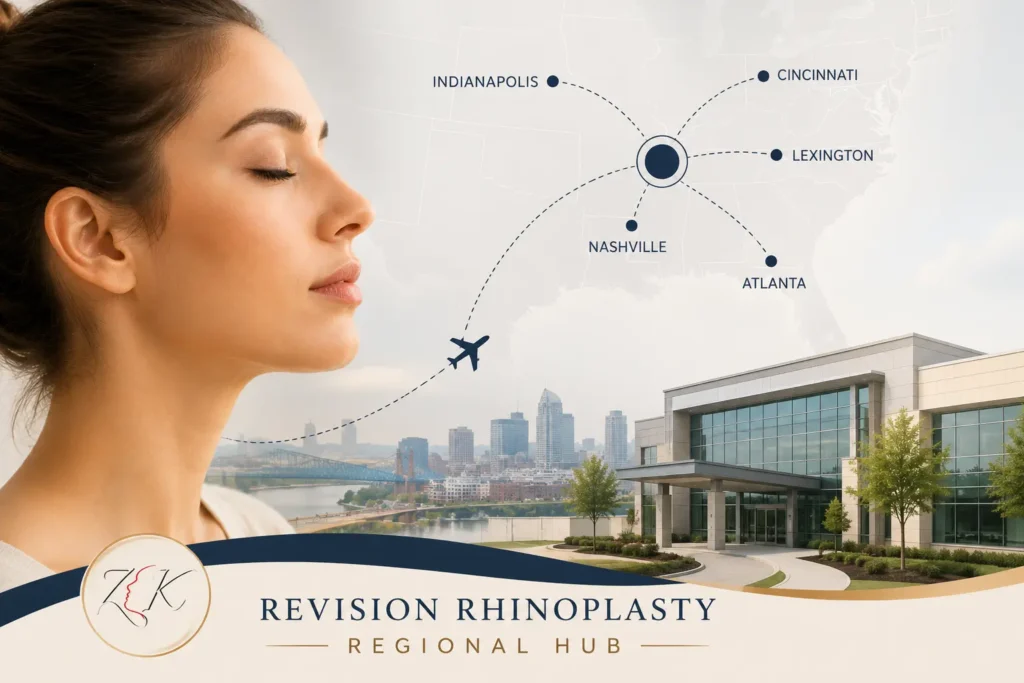
Revision cases carry higher stakes than a first time surgery, which is exactly why regional patients researching a second procedure deserve the same specialist level access as Louisville locals.
A large JAMA Facial Plastic Surgery study of 175,842 patients found that cases involving purely cosmetic dissatisfaction carried a 7.9% revision rate, and that cases requiring a rib graft, common in patients who have already had one or two prior surgeries, were independently associated with a meaningfully higher likelihood of needing further revision. This is a strong argument for getting a revision plan right the first time, especially for patients who would otherwise need to travel again for a second correction.
A separate study published through the National Institutes of Health reported an individual surgeon revision rate of 8.6% and identified a preexisting respiratory functional disorder as one of the clearest predictors of eventual revision need, reinforcing why breathing concerns should never be treated as separate from the cosmetic conversation.
For regional patients who are unhappy with a previous result, whether that means a rhinoplasty gone wrong cosmetically or breathing that never actually improved, a rhinoplasty second opinion from a specialist experienced specifically in revision and rib cartilage rhinoplasty work is worth the trip, even when the original surgery happened somewhere else entirely.
The two most common regional complaints mirror what national research shows: a residual dorsal hump removal rhinoplasty that was never fully corrected the first time, and a nasal tip that still looks unfinished long after swelling should have resolved.
Regional revision patients often carry an extra layer of hesitation, since it usually means a second trip for a surgery that was already supposed to be finished. That hesitation is understandable, but it is also exactly why getting a proper evaluation matters more the second time around, not less. A rushed or overly cautious second opinion can leave a patient stuck with the same unresolved problem for years.
Dr. Katrib evaluates every regional revision case individually, considering whether the original surgery left enough usable cartilage, whether rib cartilage rhinoplasty is needed to rebuild adequate structural support, and whether any functional breathing issues were ever properly addressed alongside the cosmetic concern in the first place.
- A full evaluation of remaining septal and ear cartilage before recommending further correction
- Consideration of rib cartilage rhinoplasty for cases needing significant structural rebuilding
- A functional airway assessment alongside any cosmetic revision goals
- An honest conversation about realistic outcomes before a second surgery is ever scheduled
How Out of Town Consultations Work
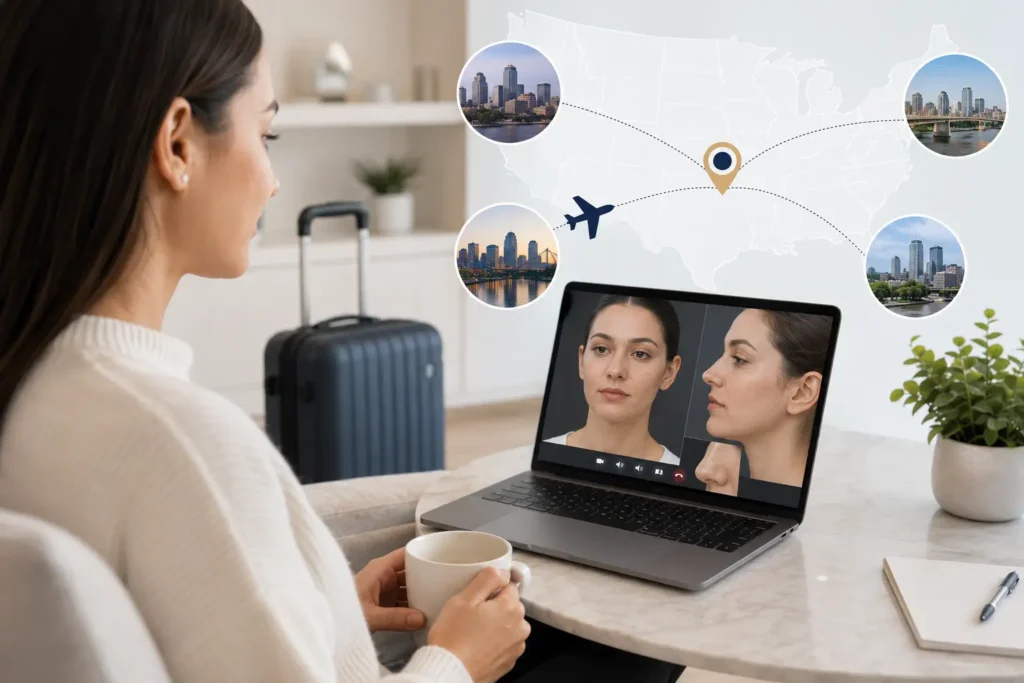
This is the part of the process regional patients ask about most, and understandably so. Nobody wants to drive hours just to have a first conversation that may not lead anywhere.
A remote rhinoplasty consultation is treated as a genuine clinical evaluation from the very first call, not a scheduling formality. You will be asked about your goals, your relevant medical history, and any breathing concerns, and you will share photos from multiple angles for a real anatomical assessment.
This matters most for regional patients specifically because it removes the single biggest barrier to seeking a specialist: the wasted trip. Nobody wants to drive ninety minutes to three hours only to learn during an in person visit that the timing is not right or that additional questions need answering first. Handling that entire evaluation virtually means the only trip you ever have to plan around is the one that actually leads to surgery.
Regional consultations tend to cover far more ground than logistics alone. Patients frequently ask about rhinoplasty swelling stages and rhinoplasty sleep position so they know what recovery actually looks like day to day, whether ethnic rhinoplasty techniques apply to their specific skin and cartilage type, how rhinoplasty age requirements affect a teenager in the family who is asking about the procedure, whether rhinoplasty for men calls for a different surgical approach than it would for a female patient, and how rhinoplasty insurance coverage might apply if a breathing concern is part of the picture. All of it gets addressed in the same virtual conversation.
- Step one: schedule a virtual consultation from Indianapolis, Lexington, Cincinnati, or anywhere else in the region
- Step two: review your goals, medical history, and photos with Dr. Katrib directly over video
- Step three: receive an honest, specific surgical plan before committing to any travel
- Step four: schedule your single in person trip for the pre operative visit and surgery
- Step five: recover with remote, video and photo based follow up support back home
Book Your Regional Consultation
If you have already searched locally in Indianapolis, Lexington, or Cincinnati and come away wanting a surgeon whose entire practice centers on the nose, the next step is simple. Booking a virtual consultation costs you a single video call, not a day off work or a tank of gas.
For patients weighing whether the trip to Louisville is worth it, the full picture of Dr. Katrib’s practice, credentials, and case focus is covered on our main practice page, Rhinoplasty Specialist Louisville KY, alongside this regional guide built specifically for patients coming from outside Kentucky.
There is no reason to keep comparing local directory listings that all start to look the same after the third or fourth search. A single virtual consultation gives you a direct, honest answer about whether traveling to Louisville actually makes sense for your specific goals, and that answer is worth far more than another afternoon spent scrolling through generic before and after photos that could belong to any surgeon anywhere.
Conclusion
Patients searching for a rhinoplasty specialist serving Indianapolis, Lexington and Cincinnati are usually doing so after already exhausting local options and coming away wanting something more specialized. That instinct is a reasonable one for a procedure this technically demanding, and the data on domestic medical travel backs it up directly. Dr. Ziad Katrib built this regional hub specifically because Indianapolis, Lexington, and Cincinnati patients deserve the same specialist level access as someone who happens to live in Louisville. Whether the drive is ninety minutes from Lexington or closer to three hours from Indianapolis, the process is designed to minimize how much of that distance actually disrupts your life. A single video call starts the conversation. A single trip typically covers the surgery itself.
And remote follow up means the miles between you and Louisville barely factor into your day to day recovery. If you have been putting off rhinoplasty simply because the right specialist felt too far away, that distance is more manageable than it appears from where you are sitting right now. A rhinoplasty specialist serving Indianapolis, Lexington and Cincinnati is not a compromise on convenience. It is what patients across this region choose specifically because it gets them a better result.
Frequently Asked Questions
Is it really worth traveling to Louisville instead of choosing a surgeon in Indianapolis, Lexington, or Cincinnati?
For many patients, yes. Research on domestic medical travel has found that patients who travel to more specialized, higher volume surgeons tend to experience fewer complications, which is exactly why a rhinoplasty specialist serving Indianapolis, Lexington and Cincinnati exists as a dedicated regional option rather than expecting patients to simply settle locally.
How many trips to Louisville will I actually need to make?
Most regional patients need just one trip, covering the pre operative visit and surgery day, since the initial consultation happens virtually from home. Occasional in person follow up later is only needed if your specific case calls for one.
Does this practice handle revision cases for patients who had surgery somewhere else?
Yes. Revision rhinoplasty, including complex cases requiring rib cartilage rhinoplasty for structural rebuilding, is a core focus, and a rhinoplasty second opinion is always welcomed regardless of where your original surgery took place.
Which of the three regional cities is closest to Louisville?
Lexington is the closest at roughly eighty miles, followed by Cincinnati and Indianapolis, both around ninety minutes to three hours depending on traffic and starting point.
Can breathing problems be addressed during the same trip as a cosmetic consultation?
Yes. Rhinoplasty for breathing problems is frequently evaluated alongside cosmetic goals during the same virtual consultation, so regional patients do not need a separate appointment for functional concerns.